Toros Hydroelectric Power Plant
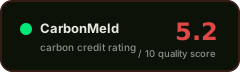
Score Breakdown
Integrity
verified The validation/verification record indicates additionality was assessed via an investment test and confirmed by the VVB.
missing Baseline/quantification reliability is weakened by contradictions in grid emission factor values and leakage treatment across official documents.
Transparency
verified The extracted record includes key MRV fields (monitoring period, methodology version, grid EF year) and shows claimed ERs equal verified ERs for the latest period.
missing Transparency is reduced by internal inconsistencies across reports on safeguards/FPIC, grievance mechanism, and core accounting parameters.
Claim Safety
verified Claimed and verified ERs match for the latest monitoring period in the monitoring report (2024).
missing CORSIA and CCP statuses were not found in the extracted record, and contradictions in ER totals and crediting period increase greenwashing/over-crediting risk.
Documentation
verified A relatively complete document set is indicated (PDD, monitoring reports, validation report, issuance) with 22 documents used and high extraction confidence.
missing Repeated contradictions between documents suggest document control/versioning issues even if documents are available.
Detailed Analysis
Integrity
Additionality appears reasonably supported because the validation/verification record indicates an investment test and that additionality was confirmed by the VVB (Re-carbon Ltd.). The project uses ACM0002 with a project-specific baseline, and the extracted record notes a baseline reassessment in 2024, which is a positive signal. Integrity is nevertheless discounted because leakage is shown as a 0% deduction while the monitoring report (2024-07-10) does not address leakage, and key quantification inputs (grid emission factor) differ across validation documents.
Transparency
The monitoring report dated 2024-07-10 provides a defined monitoring period (2022-01-01 to 2023-05-16) and reports claimed ERs equal to verified ERs (134,610), with no material findings or corrective actions listed. The evidence set is fairly complete (PDD, monitoring report, validation report, issuance) and the extraction confidence is high. However, transparency is undermined by conflicting statements across documents on safeguards/FPIC, grievance mechanism, benefit sharing, and even core accounting figures, making it harder for third parties to reconcile what is being claimed.
Claim Safety
Over-crediting/claims risk is elevated because the extracted record shows major inconsistencies in verified ER totals across validation reports, and the crediting period dates also conflict between monitoring and validation documents. Leakage is particularly problematic for claims: a 0% leakage deduction is reported, but leakage is either not addressed (monitoring report, 2024-07-10) or deemed negligible (validation report, 2024-08-02), which weakens the defensibility of “no leakage” claims. CORSIA eligibility and CCP status were not found in the extracted record, so buyers cannot rely on those labels to reduce reputational risk.
Documentation
Documentation coverage is relatively strong: 22 documents were used, the minimum extraction confidence is high, and the evidence list includes core document types (PDD, monitoring report, validation report, issuance). The latest monitoring report is recent (2024-07-10) and includes MRV outcomes and findings status. Still, repeated contradictions across official documents indicate version control and consistency problems, which reduces confidence even when documents exist.
Overall
Overall scoring is pulled down primarily by contradictions that affect credit quantification and eligibility boundaries. For leakage, the monitoring report (2024-07-10) stating leakage was not addressed is privileged over the validation report (2024-08-02) claiming it was deemed negligible, because the monitoring report is the period-specific MRV document and should explicitly justify any 0% leakage deduction; the inconsistency reduces integrity and claim safety. For safeguards/FPIC and grievance mechanism, the most recent monitoring report (2024-07-10) is privileged over older monitoring/validation statements (2020-12-04; 2015-05-11), but the flip-flopping suggests reporting inconsistency and lowers transparency. For verified ER totals (134,610 vs 57,622), the value aligned with the monitoring report’s claimed/verified ERs (134,610) is privileged, but the presence of a materially different validation figure is a major reliability red flag. For grid emission factor (0.4616 vs 0.53323) and crediting period dates (2013–2023 vs 2023–2033), the more recent validation report (2024-10-14) is privileged for those specific fields, yet the conflicts indicate a non-trivial risk of misinterpretation or misapplication across documents.
Audit Analysis
The project has a clear VCS setup with ACM0002 and an investment additionality test confirmed by the VVB, and the latest monitoring record shows no material findings or corrective actions. However, multiple cross-document inconsistencies (notably around verified ERs, crediting period dates, leakage treatment, and safeguards/FPIC) reduce confidence in baseline/quantification reliability and increase over-crediting and claims risk.
Project Description
The Toros Regulator and Hydro Power Plant generates electricity without emitting airborne pollutants or GHG emissions. It has a capacity of 49 MW and produces 239,400.00 MWh of electricity annually, reducing CO2e emissions by 126,911 tonnes each year. Additionally, the project prevents the need for conventional thermal power plants in Turkey.
Red Flags
- Conflicting verified emission reductions across validation documents (134,610 vs 57,622) creates over-crediting risk.
- Crediting period dates conflict between monitoring and validation documents, creating uncertainty about eligibility boundaries for issued credits.
- Leakage treatment is inconsistent (not addressed vs deemed negligible) despite a stated 0% leakage deduction.
Credit Vintages
| Issued | Retired | Available | ||
|---|---|---|---|---|
| 2013 | 10,227 | 10,227 | 0 | |
| 2014 | 68,293 | 68,293 | 0 | |
| 2015 | 105,672 | 105,672 | 0 | |
| 2016 | 56,861 | 56,861 | 0 | |
| 2017 | 106,916 | 106,916 | 0 | |
| 2018 | 116,412 | 98,566 | 17,846 | |
| 2019 | 128,596 | 0 | 128,596 | |
| 2020 | 123,206 | 66,860 | 56,346 | |
| Total | 716,183 | 513,395 | 202,788 |
Cosa migliorerebbe questo punteggio
- Publish a reconciled parameter/ER table (by monitoring period) that explains the 57,622 vs 134,610 discrepancy and clearly ties each issuance to a specific monitoring report and verification statement.
- Provide an explicit leakage assessment consistent across validation and monitoring reports (even if negligible) and document the basis for the selected grid emission factor and the correct crediting period dates.
Questi suggerimenti indicano quali prove pubbliche aggiuntive potrebbero migliorare il livello di confidenza di questa valutazione. Non garantiscono un punteggio futuro più alto.
Risk Indicators
Investment test confirmed by VVB
Avoidance project; no reversals reported
0% deduction but justification inconsistent
Project-specific baseline; key inputs conflict
Safeguards/FPIC reporting inconsistent
CORSIA/CCP status not stated
Where to buy
Marketplaces
+ Know where to buy this?
Listing multiple projects? Send us a CSV at [email protected].
⚑ Dispute this rating
Sei il proprietario di questo progetto?
Correzione metadati (gratuita)
Nome, paese, marketplace o link errati? Segnalacelo.
Non modifica lo score.
[email protected] →Rivalutazione con nuovi documenti
Hai documentazione aggiornata non ancora inclusa? Puoi richiedere un nuovo run della pipeline con i nuovi input.
Invia Documenti →