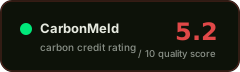
VPA 94 - GHG Emission Reduction through use of Bondhu Chula (Improved Cook Stoves) in Bangladesh
GS-3800 ↗ · current registry ID: GS11841
#413of 1329 in Industrial#66of 121 in Bangladesh#660of 1801 in Gold Standard (GS)
Audit Analysis
A Gold Standard cookstove VPA in Bangladesh with a VVB-confirmed combined additionality test and a quantified 5% leakage deduction, but undermined by a 53× gap between the lifetime ex-ante estimate and the single-period verified ERR, a project-specific baseline with no documented reassessment, no buffer pool, and a long list of corrective actions spanning formatting, stakeholder consultation, and design-change documentation. The project is CCP-eligible but CORSIA status is unstated, and multiple cross-document contradictions (FPIC, safeguards, FNRB method, crediting period) reduce confidence in the data record.
Red Flags
- Verified ERR of 523,571 tCO₂e for a single 12-month monitoring period is approximately 53× the pro-rata expectation of ~9,829 tCO₂e derived from the 49,146 tCO₂e lifetime ex-ante estimate over a 5-year crediting period — a discrepancy that cannot be explained by normal project growth and suggests either a scope/unit mismatch or a significant over-crediting risk.
- FPIC is recorded as not conducted in the 2024 verification report, contradicting the 2023 validation report which states it was conducted; the more recent and authoritative verification report is privileged, leaving a safeguards gap.
- No buffer pool percentage is stated in any available document, and no reversal events are documented, leaving permanence risk unquantified for a project whose stoves have a finite service life.
- Eighteen or more corrective actions were raised by the VVB and GS, covering grievance-book implementation, stakeholder-consultation timing, PoA duration compliance, and missing design-change records — indicating systemic documentation and process weaknesses.
- The PDD lists a 28-year crediting period (2014–2042) while the validation report and current VPA use a 5-year period (2021–2026); the 28-year figure was explicitly challenged in material findings (CAR 02) and resolved via transition rules, but the inconsistency persists across documents.
Credit Vintages
| Issued | Retired | Available | ||
|---|---|---|---|---|
| 2022 | 5,355 | 5,355 | 0 | |
| 2023 | 8,439 | 0 | 8,439 | |
| Total | 13,794 | 5,355 | 8,439 |
Risk Indicators
Combined test, VVB-confirmed
reversal risk unquantified
5% quantified deduction with justification
Project-specific; no reassessment date found
Grievance mechanism present; FPIC not conducted per VR
CCP-eligible; CORSIA status not stated
⚑ Dispute this rating
Are you the project owner?
Metadata correction (free)
Name, country, marketplace or links incorrect? Let us know.
Does not modify the score.
[email protected] →Pipeline re-run with new documents
Have updated documentation not yet included? You can request a new run of the pipeline with the new inputs.
Submit Documents →Share this rating