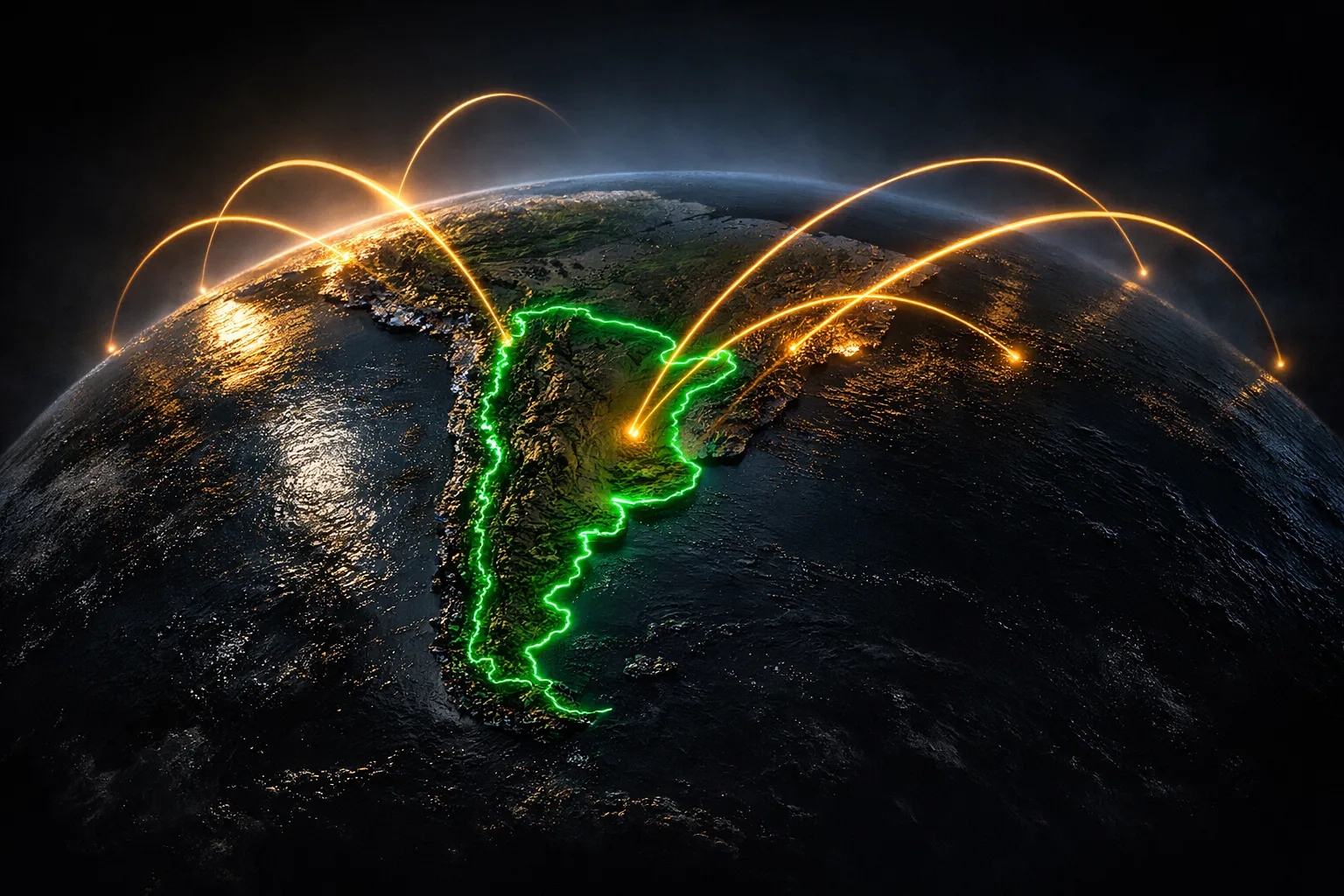
Argentina has formally submitted its third Nationally Determined Contribution (NDC), a filing that opens the door for the country to participate in carbon market mechanisms under Article 6 of the Paris Agreement and provides a path for projects, including a jurisdictional REDD+ programme, seeking international buyers, according to Carbon Pulse. For developers holding Argentine mitigation assets and for buyers of internationally transferred mitigation outcomes, the submission turns a long delayed climate plan into the precondition for carbon market cooperation that the government itself had described as indispensable.
A 375 MtCO2e net ceiling for 2030 and 2035
The NDC 3.0 commits Argentina not to exceed net emissions of 375 MtCO2e in 2030, and to hold net emissions without exceeding the same ceiling in 2035, according to the submission text. The target covers all gases and all reported emission source and sink categories from the country’s First Biennial Transparency Report, which included the 2022 national greenhouse gas inventory and was presented to the UNFCCC in December 2024, according to the Subsecretaría de Ambiente.
The new contribution incorporates methodological improvements over its predecessor: territorial coverage rises from 65% to 79%, reported emission categories increase from 146 to 162, and the metrics switch to the IPCC’s AR5 global warming potentials, according to the Subsecretaría de Ambiente. The government argues that, because of these changes, 375 MtCO2e for 2030 to 2035 is a lower ceiling than the 349 MtCO2e set for 2025 to 2030 in the previous NDC, which was submitted in 2021, according to FARN.
That equivalence is contested. FARN, an Argentine environmental foundation, argues that assessing whether mitigation effort has actually increased requires a reproducible calculation comparing both targets under the same methodology and separating the effect of accounting changes from that of policies, according to FARN. The group also notes that Argentina commits to the same limit for 2030 and 2035 without explaining why that represents its highest possible ambition, and that, based on the European Commission’s EDGAR database, Argentina ranked 27th among global greenhouse gas emitters in 2025, a comparison that excludes land use, land use change and forestry.
What changes on Article 6
The NDC recognizes the complementary role of cooperation mechanisms and international financing, prioritizing private investment opportunities and voluntary carbon markets or similar initiatives, according to the submission text. One of the most significant changes in the document is the modification of Argentina’s stance toward carbon markets, especially in relation to Article 6: the text expresses the country’s intention to participate in bilateral, regional or multilateral voluntary cooperation mechanisms, opening the door to international transaction and collaboration schemes, according to Argentina Forestal, which describes the explicit recognition of carbon markets inside the NDC as a very important step.
The government framed the filing in exactly those terms. Article 6, through carbon markets applied with the clear objective of contributing to the fulfilment of the NDC 3.0, can be a great incentive for mitigation actions to occur, said Nazareno Castillo Marín, national director of Sustainable Development and Climate Management, who stressed that updating and submitting the contribution was an indispensable requirement to participate in these markets: without an NDC 3.0, there are no carbon markets under Article 6, according to the Subsecretaría de Ambiente.
A late filing and a contested process
The NDC was submitted on Friday, well beyond the original deadline, according to Carbon Pulse. Argentina formally presented the document on 6 November 2026, more than a year after announcing preliminary results, and days before COP31, according to FARN. The foundation argues that the delay did not translate into a roadmap explaining how the target will be reached, and that the process fell short on participation: the External Advisory Council was not convened, and the only expanded session mentioned in the document was a YouTube broadcast with the chat closed and no possibility of questions or exchange.
The government presents the process differently. Environment Undersecretary Fernando Brom said the NDC shows Argentina is doing its homework on environmental policy, with achievable and realistic objectives for 2030 and 2035, while Eliana Saissac, director of Environmental Affairs at the foreign ministry, described a participatory effort across the national cabinet, provinces, civil society and academia, according to the Subsecretaría de Ambiente. Alongside the NDC, Argentina also presented its third Adaptation Communication, prepared in line with international guidelines.
Implications for buyers and developers
For project developers, the immediate significance is that the filing removes the formal barrier the government itself had identified: participation in Article 6 cooperation is now an expressed national intention rather than an open question, and the NDC explicitly provides a path for projects, including a jurisdictional REDD+ programme, seeking international buyers, according to Carbon Pulse. Argentina’s stated interest in bilateral, regional or multilateral mechanisms suggests supply could eventually flow through several cooperation formats rather than a single channel.
For buyers, the signal comes with caveats. The NDC states an intention to cooperate and prioritizes private investment and voluntary carbon markets, but the credibility debate around the 375 MtCO2e ceiling, and the absence so far of a published roadmap or a reproducible comparison with the previous 349 MtCO2e target, are due diligence points when assessing the country’s mitigation trajectory.
What to watch
Three markers will determine how the open door translates into transactions. First, whether Argentina converts its stated intention into concrete bilateral or multilateral cooperation agreements under Article 6. Second, whether the government publishes the methodological comparison between the 349 and 375 MtCO2e ceilings that FARN has demanded. Third, how the participation criticisms are addressed as the country moves from submission toward implementation of the 2030 and 2035 targets.