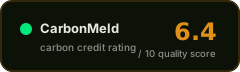
5MW Biomass Based Cogeneration Project At Sainsons
Score Breakdown
Integrity
verified Additionality was confirmed by the VVB using an investment test, which supports the project case.
missing Leakage is weakly supported because the monitoring report says it was not addressed, and buffer pool coverage is not stated.
Transparency
verified The project has a named VVB, a defined monitoring period, and a monitoring report with no material findings reported.
missing Total verified emission reductions conflict across documents, and the usage monitoring method is not stated in available documents.
Claim Safety
verified The project is marked as not CORSIA-eligible, which reduces one channel of double-claim risk.
missing The baseline is project-specific rather than a clearly standardized or jurisdictional baseline, and leakage treatment is inconsistent.
Documentation
verified Multiple official documents were available, including validation, monitoring, PDD, and issuance records, and extraction confidence is high.
missing Several key items are not stated in available documents, including buffer pool coverage, baseline reassessment timing, and usage monitoring details.
Detailed Analysis
Integrity
The project’s additionality case is reasonably strong because the validation report confirms an investment test and the VVB accepted it. However, the monitoring report says leakage was not addressed, while the contradiction log says another validation document described leakage as quantified, so the leakage treatment is not fully reliable. No reversal events are reported, but buffer pool coverage is not stated in available documents, which limits permanence confidence.
Transparency
The record includes a named VVB, a monitoring period from 2020-10-01 to 2021-12-31, and no material findings in the monitoring report. Transparency is weakened by the conflicting verified emission reduction totals across validation records and by the fact that the usage monitoring method is not stated in available documents. The project is not CORSIA-eligible, which is clear, but registry completeness is still limited by missing operational detail.
Claim Safety
Claim safety is moderate at best because the project uses a project-specific baseline and the leakage story is inconsistent across documents. The project is marked as not CORSIA-eligible, which helps reduce dual-market risk, but CCP status is not found in the extracted record. The large discrepancy in verified emission reduction totals also creates over-crediting and claim reliability concerns.
Documentation
Documentation is fairly broad, with validation, monitoring, PDD, and issuance materials among the evidence documents used, and extraction confidence is high. The monitoring report also notes that five corrective action requests were raised and resolved satisfactorily, which supports process completeness. Even so, several important items are not stated in available documents, including buffer pool percentage, baseline reassessment timing, and usage monitoring details.
Overall
Overall, this is a mid-quality crediting record with a credible additionality basis but meaningful reliability and completeness issues. I privileged the more recent monitoring report for operational facts such as the monitoring period and leakage treatment, but I also noted the older validation report where it provided a more specific claim; the contradiction over verified emission reductions is especially concerning because the record shows 29,664 in one place and 67,151 in another. The contradiction on leakage justification and the shift in safeguard statements across documents further reduce confidence in the consistency of the file.
Audit Analysis
This is a registered VCS biomass cogeneration project with VVB-confirmed additionality and no material findings reported, but the evidence record has important inconsistencies. The biggest concerns are the conflicting verified issuance totals, a leakage justification that is described as not addressed in the monitoring report, and missing detail on buffer coverage and usage monitoring.
Project Description
SPIL's 5 MW cogeneration power project, which is based on rice husk, uses a 5MW extraction-cum-condensing steam turbine with alternator to produce electricity. The project has replaced a low-pressure boiler with a 3 MW turbine, and it is expected to reduce GHG emissions by substituting electricity generation of NEWNE grid of India that is dominated by coal-based power plants, ultimately reducing coal consumption.
Red Flags
- The verified emission reduction total differs sharply across validation records, which raises reliability concerns about the issuance trail.
- Leakage treatment is inconsistent: one document says it was quantified, while the monitoring report says it was not addressed.
Credit Vintages
| Issued | Retired | Available | ||
|---|---|---|---|---|
| 2017 | 19,887 | 19,887 | 0 | |
| 2018 | 18,439 | 18,439 | 0 | |
| 2019 | 19,889 | 18,674 | 1,215 | |
| 2020 | 13,941 | 3,455 | 10,486 | |
| 2021 | 24,659 | 5,413 | 19,246 | |
| Total | 96,815 | 65,868 | 30,947 |
Cosa migliorerebbe questo punteggio
- Provide a reconciled issuance table that explains the conflicting verified emission reduction totals and identifies the authoritative figure.
- Publish a clear leakage assessment, buffer pool coverage, and usage monitoring methodology in the monitoring documentation.
Questi suggerimenti indicano quali prove pubbliche aggiuntive potrebbero migliorare il livello di confidenza di questa valutazione. Non garantiscono un punteggio futuro più alto.
Risk Indicators
VVB-confirmed investment test
No reversals reported, buffer not stated
Leakage treatment inconsistent
Project baseline, reassessment not stated
FPIC and grievance mechanism documented
Not CORSIA-eligible, CCP not stated
Where to buy
Marketplaces
+ Know where to buy this?
Listing multiple projects? Send us a CSV at [email protected].
⚑ Dispute this rating
Sei il proprietario di questo progetto?
Correzione metadati (gratuita)
Nome, paese, marketplace o link errati? Segnalacelo.
Non modifica lo score.
[email protected] →Rivalutazione con nuovi documenti
Hai documentazione aggiornata non ancora inclusa? Puoi richiedere un nuovo run della pipeline con i nuovi input.
Invia Documenti →