Bikes for the Planet - Brazil
#220of 500 in Brazil#983of 1608 in Verra (VCS)
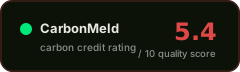
Score from methodology v2.1 (analysis of 1 Sep 2026). Re-assessment under v2.2 pending.
Assessment
Scale 0–10 · method weights: integrity 35% · transparency 25% · claim safety 25% · documentation 15%.
Findings
Risk Indicators
🔒
🔒
🔒
🔒
🔒
🔒
Score Breakdown
Score factors per dimension are a Premium feature — Unlock with Premium
Detailed Analysis
The detailed per-dimension analysis is a Premium feature — Unlock with Premium
Evidence
Eligibility & market
What can you claim with this credit?
Four checks buyers ask about, from the registry and the Integrity Council (ICVCM).
Airlines (CORSIA)
No CORSIA label on the registry
Not usable for airlines' CORSIA obligations.
Source: registry label
Integrity label (ICVCM CCP)
No ICVCM information
No CCP label and no ICVCM decision found for this project's methodology.
Removal or reduction
Emission reduction or avoidance
Prevents or reduces emissions — fits contribution claims, not SBTi neutralisation.
Source: methodology
Paris Agreement (Article 6)
No Article 6 authorization
No corresponding adjustment: the host country can also count this reduction towards its own target.
Source: registry label
Information only, from public sources. Claim rules (CORSIA, SBTi, EU rules on green claims) change: check them before making a public claim. Since 27 September 2026, EU consumer rules do not allow “climate neutral” product claims based on offsets.
Registry labels last checked:2026-10-25
Credit Vintages
| Issued | Retired | Available | ||
|---|---|---|---|---|
| 2018 | 2,549 | 2,228 | 321 | |
| 2021 | 1,504 | 0 | 1,504 | |
| 2022 | 1,015 | 0 | 1,015 | |
| Total | 5,068 | 2,228 | 2,840 |
Methodology versions used
The methodology version stated in each monitoring, verification and issuance document, by period, compared with the official methodology pages.
2018AMS-III.BM v1.0since replaced by v2.0
verification report
official page · verified on
2018–2021AMS-III.BM v1.0since replaced by v2.0
monitoring report + verification report + issuance document
official page · verified on
2021–2022AMS-III.BM v1.0since replaced by v2.0
monitoring report + verification report + issuance document
official page · verified on
- AMS-III.BM: Active (CDM / UNFCCC) · official page · verified on
A version is shown only when the document's own text writes it next to the methodology code. Current versions, status and CCP ranges come from the official pages linked, checked on the date shown.
Retired by
- StoneX Financial Inc750 t
- Municipality of Sao Paulo (Municipio de Sao Paulo)488 t
- Município de São Paulo240 t
Organisations named as beneficiaries in the registry's public retirement records.
Where to buy
Got an offer for these credits? Check it against the registry →
+ Know where to buy this?
Listing multiple projects? Send us a CSV at [email protected].
Profile & governance
Are you the project owner?
Metadata correction (free)
Name, country, marketplace or links incorrect? Let us know.
Does not modify the score.
[email protected] →Contest this rating
Something wrong in the analysis, or a registry document we have not used? Send us the link to the public source: you get a reference and an answer within 30 days.
Contest this rating →Share this rating