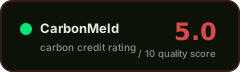
Dagachhu Hydropower Project, Bhutan
Score Breakdown
Integrity
verified DNV validation found the project additional using financial and barrier analysis [Validation Report, 2010]
inferred ACM0002 baseline and ex-post combined margin updates support baseline rigor, but the case is dated [Validation Report]
Transparency
verified Public registry record includes PDD, validation report, monitoring reports, issuance history, and participant changes
verified Multiple monitoring reports and serial ranges are publicly listed on the registry
Claim Safety
missing No evidence of CCP approval, Article 6 authorization, or corresponding adjustment
inferred Legacy CDM vintages and old issuance periods increase buyer claim risk
Documentation
verified Public PDD and DNV validation report are available [PDD, Validation Report]
verified Multiple monitoring reports are public, but the latest shown are historical rather than recent
Detailed Analysis
Integrity
The validation report by DNV states that the project is additional, citing financial barrier evidence, CDM revenue dependence, and the absence of main construction at the time of validation. It also documents a conservative methodology choice under ACM0002 and ex-post updating of the combined margin grid emission factor, which helps baseline credibility. However, this is a grid-connected hydropower project in Bhutan/India, so additionality remains somewhat mixed because the case is based on older CDM-era arguments rather than a modern, independently re-tested investment test.
Transparency
The official registry page provides the PDD, validation report, validation opinion on PDD changes, registration history, crediting periods, and multiple monitoring reports with issuance records. The project documents are publicly accessible and the registry metadata is unusually complete, including participant changes and serial ranges. The main gap is that the most recent monitoring documents shown are historical, so transparency is high but not fully current.
Claim Safety
The project is not presented as CCP-approved, and there is no evidence of Article 6 authorization or corresponding adjustment, so buyer claims should be limited to voluntary climate contribution rather than offsetting with host-country adjustment. Vintage risk is moderate because the project’s crediting periods and issuance history are old, even though the registry record is clear. Double-counting risk is reduced by the registry trail and participant authorizations, but claim safety is still below top tier because the credits are legacy CDM-era avoidance units.
Documentation
The registry includes a public PDD, a third-party validation report from DNV, and multiple monitoring reports for 2014-2019 with issuance requests marked issued. The validation report is detailed and cites the underlying feasibility study, approvals, and monitoring approach. What is missing from the provided record is a recent verification/monitoring cycle within the last two years, so the documentation is strong but dated.
Overall
Overall, this is a well-documented, registry-grade project with strong public evidence and a credible audit trail. The biggest strength is documentation: the registry record, validation report, and monitoring reports are all available and internally consistent. The main limitation is that the project is a legacy hydropower avoidance project whose additionality and claim safety depend on older CDM-era assumptions, so confidence is high on record quality but only moderate on forward-looking offset quality. For a buyer, this is a transparent historical project, but not a best-in-class current-quality credit.
Audit Analysis
This is a registry-grade project with a public Gold Standard/CDM registry record, PDD, validation report, and multiple monitoring reports. Evidence is strong on documentation and transparency, but claim safety is moderated by the project’s age and the fact that the core additionality case relies on a 2010-era financial/barrier analysis for a hydropower project in a policy-supported sector.
Red Flags
- Legacy CDM-era hydropower additionality case relies on older financial/barrier arguments rather than a recent revalidation.
- No evidence of Article 6 authorization or corresponding adjustment for buyer claims.
- Monitoring/verification evidence provided is historical rather than recent (<2 years).
Credit Vintages
Nessuna emissione registrata sul registro.
Il marketplace dichiara i vintage: 2013 (non verificato).
Cosa migliorerebbe questo punteggio
- Publish a recent verification or monitoring update covering the latest operating period and grid emission factor recalculation.
- Provide explicit buyer-claim guidance on the registry page, including whether any host-country authorization or corresponding adjustment exists.
- Disclose a current lifecycle/financial reassessment showing whether the project would still be additional under today’s Bhutan/India power-market conditions.
Questi suggerimenti indicano quali prove pubbliche aggiuntive potrebbero migliorare il livello di confidenza di questa valutazione. Non garantiscono un punteggio futuro più alto.
Risk Indicators
documented evidence
low reversal risk for run-of-river hydropower
no material leakage issue evidenced
baseline methodology is approved, but grid factors are histo
public approvals and validation documented
registry trail is clear, but no corresponding adjustment evi
Where to buy
Marketplaces
+ Know where to buy this?
Listing multiple projects? Send us a CSV at [email protected].
⚑ Dispute this rating
Registry Documents
Sei il proprietario di questo progetto?
Correzione metadati (gratuita)
Nome, paese, marketplace o link errati? Segnalacelo.
Non modifica lo score.
[email protected] →Rivalutazione con nuovi documenti
Hai documentazione aggiornata non ancora inclusa? Puoi richiedere un nuovo run della pipeline con i nuovi input.
Invia Documenti →