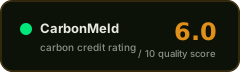
Eglence I-II Hydroelectric Power Plant
Score Breakdown
Integrity
verified Additionality is confirmed by the VVB using an investment test (validation documentation).
missing Leakage is treated as 0% but the monitoring report does not address justification, conflicting with a later validation report that says it was quantified.
Transparency
verified Claimed and verified emission reductions match at 153,507 for the 2021–2023 monitoring period (monitoring/verification documentation).
missing Key figures and terms are inconsistent across documents (notably ERR totals and crediting period), reducing confidence in the public record.
Claim Safety
missing CORSIA eligibility is not stated in the extracted record and CCP status is not mentioned, leaving downstream claim/labeling risk unresolved.
missing Contradictory ERR totals (153,507 vs 706,792) materially increase over-crediting and greenwashing risk.
Documentation
verified A relatively complete document set is referenced (PDD, monitoring report, validation report, issuance) with high extraction confidence and 16 documents used.
missing Multiple contradictions across official documents suggest version-control and record-keeping weaknesses despite good coverage.
Detailed Analysis
Integrity
The validation documentation confirms additionality via an investment test and indicates it was verified by the VVB (RINA). The monitoring report (2025-02-17) reports no reversal events, which is consistent with an avoidance renewable energy project. However, leakage is applied as a 0% deduction while the monitoring report does not address leakage justification, conflicting with a 2025 validation report that describes leakage as quantified; this inconsistency weakens confidence in the baseline/leakage treatment. The baseline is project-specific under ACM0002 and was last reassessed in 2023, which is a positive signal but still less robust than a standardized/jurisdictional baseline.
Transparency
The monitoring period is clearly stated as 2021-01-01 to 2023-04-09, and the extracted record shows claimed and verified emission reductions both equal to 153,507 for that period. The VVB is identified as RINA, and no material findings or corrective actions are reported, which supports MRV clarity. Transparency is reduced by major inconsistencies across validation documents on total emission reductions and on the crediting period dates, making it harder for third parties to reconcile what was actually validated/issued.
Claim Safety
Over-crediting risk is elevated because the extracted record contains a very large discrepancy in emission reductions between two validation reports (706,792 in 2021 vs 153,507 in 2025), which could reflect boundary/method changes or simple reporting error but is not reconciled here. Leakage claim safety is also weakened because one validation report (2025-01-16) indicates leakage was quantified while the monitoring report (2025-02-17) does not address leakage justification, yet a 0% deduction is applied. CORSIA eligibility is not stated in the extracted record and CCP status is not mentioned, so the project’s suitability for higher-integrity claims cannot be confirmed from the available extracted data.
Documentation
The evidence base appears relatively complete, referencing a PDD, monitoring report, validation report, and issuance records, with 16 documents used and high extraction confidence. The monitoring report is recent (2025-02-17), which supports recency. Despite this, repeated contradictions across documents (ERR totals, crediting period, and safeguards/grievance/benefit-sharing/FPIC statements) indicate documentation governance issues that reduce confidence in the record even when documents exist.
Overall
Overall quality is moderate: additionality is VVB-confirmed and baseline reassessment is recent, but reliability concerns are driven by multiple contradictions. For emission reductions, I privilege the 153,507 figure because it aligns with the monitoring-period-specific accounting (2021–2023) and matches claimed vs verified in the extracted record, whereas the 706,792 figure appears inconsistent with that monitoring window and is from an older validation report (2021-09-30). For leakage, I privilege the monitoring report’s statement that leakage justification is not addressed (more directly tied to the monitored issuance period) over the validation report’s claim of quantification, and I discount integrity/claim safety accordingly. For safeguards (FPIC, grievance mechanism, benefit sharing), I privilege the more recent monitoring report (2025-02-17) indicating these are present, but the contradiction with the 2013 validation report still warrants a downward adjustment for transparency and documentation reliability. The crediting period conflict is unresolved; I privilege the monitoring report’s 2013–2023 period as it matches the stated end date of the monitoring period, but the presence of a 2023–2033 period in a 2025 validation report suggests possible renewal/second period that is not clearly documented here, increasing uncertainty.
Audit Analysis
The project shows some core integrity strengths (VVB-confirmed investment additionality and a recent baseline reassessment), but several internal inconsistencies across documents raise reliability and over-crediting concerns. Leakage treatment and key social safeguard disclosures are contradictory between older validation and the latest monitoring, which increases claim risk despite generally solid documentation coverage.
Project Description
The Eglence I-II hydroelectric power plant, situated on the Eglence River in Turkey, has a total installed capacity of 68.65 MWe. With two weirs and two powerhouses, the plant generates approximately 205,299 MWh of clean energy annually, reducing CO2 emissions by an estimated 114,065 tonnes per year.
Red Flags
- Large discrepancy in reported emission reductions (153,507 vs 706,792) across validation documents, indicating potential over-crediting or reporting errors
- Leakage is recorded as a 0% deduction but the justification is inconsistent (quantified in one validation report vs not addressed in the monitoring report)
Credit Vintages
| Issued | Retired | Available | ||
|---|---|---|---|---|
| 2019 | 256,758 | 39,688 | 217,070 | |
| 2020 | 190,786 | 70,840 | 119,946 | |
| Total | 447,544 | 110,528 | 337,016 |
Cosa migliorerebbe questo punteggio
- Publish a reconciled ERR table explaining why validation documents show 706,792 vs 153,507 (scope, monitoring period alignment, methodology inputs, or corrections) and link it to issuance records.
- Provide a clear leakage assessment consistent across validation and monitoring (even if 0%), and document safeguards evidence (FPIC records, grievance process, benefit-sharing arrangements) with dates and stakeholder engagement outputs.
Questi suggerimenti indicano quali prove pubbliche aggiuntive potrebbero migliorare il livello di confidenza di questa valutazione. Non garantiscono un punteggio futuro più alto.
Risk Indicators
VVB-confirmed investment test
Avoidance project; no reversals reported
0% deduction with inconsistent justification
Project-specific baseline; reassessed in 2023
Safeguards/FPIC reported but inconsistent over time
CORSIA/CCP status not confirmed in record
Where to buy
Marketplaces
+ Know where to buy this?
Listing multiple projects? Send us a CSV at [email protected].
⚑ Dispute this rating
Sei il proprietario di questo progetto?
Correzione metadati (gratuita)
Nome, paese, marketplace o link errati? Segnalacelo.
Non modifica lo score.
[email protected] →Rivalutazione con nuovi documenti
Hai documentazione aggiornata non ancora inclusa? Puoi richiedere un nuovo run della pipeline con i nuovi input.
Invia Documenti →