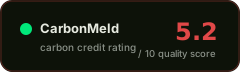
Improved Cookstoves for Rural Zambia
Score Breakdown
Integrity
verified Additionality was confirmed by the VVB using a combined test, and the monitoring report reports no reversal events.
missing The project uses a project-specific baseline and the record does not show a recent baseline reassessment or a buffer pool contribution.
Transparency
verified The monitoring report names the VVB, states the monitoring period, and provides claimed versus verified emissions reductions.
missing The report contains multiple corrective actions and requests for missing evidence, and the extraction confidence is low.
Claim Safety
verified Leakage is treated as negligible with a very small deduction, and the verified usage rate is reported at 79% versus 75% assumed.
missing The record contains contradictions in emissions reductions, usage rates, and leakage wording, which raises over-crediting risk.
Documentation
verified The record includes a monitoring report, validation report, and a relatively large number of extracted facts.
missing Several key supporting documents were requested but not found in the extracted record, and the extraction confidence is low.
Detailed Analysis
Integrity
The project’s additionality is stronger than average because the monitoring record says the VVB confirmed it through a combined test. Permanence risk looks limited for an avoidance cookstove project, and the report says no reversal events were reported. On the weaker side, the baseline is project-specific and the record does not show when it was last reassessed, while buffer pool coverage is not stated in the available documents.
Transparency
Transparency is moderate because the monitoring report identifies Earthood Services Private Limited, gives the monitoring period, and reports both claimed and verified emissions reductions. At the same time, the report includes many corrective actions and asks for missing evidence such as survey records, training records, sales evidence, and a no-double-counting declaration. The low extraction confidence also suggests at least one key document was difficult to read.
Claim Safety
Claim safety is mixed. The monitoring report states a negligible leakage treatment with a 0.01% deduction, and the verified usage rate is 79% compared with 75% assumed, which is directionally supportive. However, the contradictions show different values for usage rates, leakage wording, and emissions reductions across documents, so I privileged the more recent monitoring report where it was the most specific source.
Documentation
Documentation quality is limited by missing or unstated items in the extracted record. The evidence set includes a monitoring report and validation report, but many requested supporting materials were not found, and the report itself lists numerous corrective actions. Because min extraction confidence is low, the documentation score is pulled down further.
Overall
I privileged the 2025 monitoring report over older or unspecified sources when values conflicted, because it is the most recent and project-specific document in the record. That said, the contradictions in usage rates, leakage treatment, total emissions reductions, and crediting-period dates materially reduce reliability, so the scores are adjusted downward. The project is not weak enough to trigger the integrity gate, but the documentation and transparency weaknesses keep the overall assessment only moderate.
Audit Analysis
This is a certified Gold Standard cookstove project with VVB-confirmed additionality, a quantified leakage deduction, and no reported reversal events. However, the monitoring package has multiple internal inconsistencies, several required supporting documents were not provided, and the low extraction confidence reduces trust in the record.
Project Description
Over 700 million Africans cook on open fires, which are extremely inefficient and a primary cause of deforestation across the continent. Open fire cooking is also the leading source of household air pollution (HAP), causing over 4 million premature deaths each year, more than tuberculosis and HIV combined. Improved cook stoves (ICS) can reduce HAP by up to 50% and fuel use by up to 70%. TASC has distributed over 145,000 stoves in rural Zambia and reduced CO2 emissions by over 750,000 tonnes to date. Our local team works closely with tribal authorities to introduce and train the local communities to use and maintain their stoves. After the stoves are distributed we continue to visit beneficiaries for ongoing monitoring in the community. We are proud to note that the heat sensors recently installed on our ICS as part of a pilot programme have objectively proven usage rates of 97% and at a minimum, single daily usage of the stoves. This pilot is done voluntarily in our attempt to calculate emissions reductions with impartiality. Project Impacts and Benefits The primary impact of the clean cooking programme is to reduce CO2 emissions by reducing the amount of non-renewable biomass that is used in household cooking. Consumption of local wood fuel is reduced by up to 70%. The introduction of an improved cooking solution also reduces exposure to the indoor air pollutants associated with traditional biomass cooking. Furthermore, in the poorest communities, the burden of collecting and/or purchasing fuel for cooking often falls on women and children. By reducing fuel collection and cooking time, this project ensures that women in project households have more time to invest in other productive economic development activities. Finally, the implementation of the project allows for the employment of the local community to assist with the distribution, logistics, management, and monitoring activities. The project contributes to multiple Sustainable Development
Red Flags
- The monitoring report lists several unresolved findings and corrective actions, including inconsistent monitoring-period dates and missing evidence for key sampling and distribution records.
- There are contradictions in usage rates, emissions reductions, leakage treatment, and crediting-period dates across documents, which weakens reliability.
Credit Vintages
| Issued | Retired | Available | ||
|---|---|---|---|---|
| 2021 | 2,960 | 2,960 | 0 | |
| 2022 | 4,661 | 4,624 | 37 | |
| 2023 | 4,750 | 4,009 | 741 | |
| 2024 | 2,493 | 454 | 2,039 | |
| Total | 14,864 | 12,047 | 2,817 |
Cosa migliorerebbe questo punteggio
- Provide the missing supporting evidence requested in the monitoring report, especially survey records, KPT records, sales/distribution evidence, and the no-double-counting declaration.
- Resolve the internal contradictions in monitoring dates, usage rates, leakage treatment, and emissions reductions, and publish a clear reconciliation note tied to the latest monitoring report.
Questi suggerimenti indicano quali prove pubbliche aggiuntive potrebbero migliorare il livello di confidenza di questa valutazione. Non garantiscono un punteggio futuro più alto.
Risk Indicators
VVB-confirmed combined test
Avoidance project; no reversals reported
Negligible leakage deduction stated
Project baseline; reassessment timing missing
FPIC and grievance mechanism documented
CORSIA/CCP status not stated
Where to buy
Marketplaces
+ Know where to buy this?
Listing multiple projects? Send us a CSV at [email protected].
⚑ Dispute this rating
Sei il proprietario di questo progetto?
Correzione metadati (gratuita)
Nome, paese, marketplace o link errati? Segnalacelo.
Non modifica lo score.
[email protected] →Rivalutazione con nuovi documenti
Hai documentazione aggiornata non ancora inclusa? Puoi richiedere un nuovo run della pipeline con i nuovi input.
Invia Documenti →