Improving livelihoods through Agroforestry Plantations in India
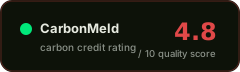
Score Breakdown
Integrity
verified Additionality was confirmed by the VVB, and the verification report reports no material findings or corrective actions.
missing Permanence is only partially supported: reversal events are marked as not addressed, and no buffer pool percentage is stated.
Transparency
verified The monitoring period is clearly stated, and the verification report identifies Carbon Check (India) Private Limited as the VVB.
missing Key MRV details are missing, including claimed versus verified ER totals, usage monitoring method, and any public registry completeness indicators.
Claim Safety
verified The project is explicitly marked as not CORSIA-eligible, which reduces dual-market claim risk.
missing Baseline and leakage evidence are incomplete: the baseline is project-specific, leakage is only described as quantified without a percentage, and FNRB is not applicable rather than clearly benchmarked.
Documentation
verified The record includes a verification report with ten extracted facts and no corrective actions required.
missing Extraction confidence is low, the evidence documents are not clearly enumerated, and multiple contradictions indicate uneven document quality.
Detailed Analysis
Integrity
The verification report confirms additionality through a combined test and says the VVB found no material findings or corrective actions. That supports the project, but permanence is weaker because reversal events are marked as not addressed and no buffer pool percentage is stated. Leakage is at least acknowledged as quantified, which is better than silence, but the underlying deduction amount is not available in the extracted record.
Transparency
Transparency is limited by missing core MRV fields: the record does not state claimed versus verified ER totals, the usage monitoring method, or any registry completeness details. The monitoring period is clearly identified, and the VVB is named as Carbon Check (India) Private Limited, which helps, but the low extraction confidence reduces trust in completeness. The absence of quantified public-facing reporting elements keeps this below a strong transparency score.
Claim Safety
Claim safety is mixed. The project is explicitly not CORSIA-eligible, which lowers dual-claim risk, but the baseline is project-specific rather than a clearly standardized or recently reassessed jurisdictional baseline. Leakage is only described as quantified, without a percentage or supporting detail, and the FNRB field is marked not applicable rather than providing a benchmark against national defaults.
Documentation
Documentation quality is moderate but not strong. The record includes a verification report and no corrective actions, yet the evidence list is not specific and the extraction confidence is low, indicating at least one key source was difficult to read. The long crediting period is stated, but the contradictions across documents and missing supporting details reduce confidence in the completeness of the file.
Overall
I privileged the 2026-02-13 verification report where it conflicts with earlier documents, because it is the most recent and appears to be the highest-priority assurance source. That means I accepted the later values for safeguards, grievance mechanism, FPIC, leakage treatment, reversal handling, benefit sharing, additionality test type, and crediting period, while still penalizing the score because the contradictions themselves indicate reliability risk. The project is not CORSIA-eligible and has some positive verification signals, but the missing permanence, MRV, and documentation details keep the overall assessment in the mid range.
Audit Analysis
The project has some positive integrity signals, including VVB-confirmed additionality, no material findings, and a quantified leakage treatment. However, key permanence and documentation elements are weak or missing, and the record contains several contradictions across documents that reduce confidence. Overall, this looks like a moderate-quality project with meaningful evidence gaps rather than a high-confidence crediting case.
Project Description
Proponent: Infinite Environmental Solutions Limited Protocol categories: Agriculture Forestry and Other Land Use Protocols: AR-ACM0003 Estimated annual GHG reductions: 5990 tCO2e Region: Asia Registration date: 2026-02-13
Red Flags
- The record does not state a buffer pool, and reversal handling is not clearly addressed despite a long crediting period.
- Several contradictions exist across documents on safeguards, grievance mechanisms, FPIC, leakage treatment, and crediting period timing.
- Extraction confidence is low and the evidence list is not specific, which weakens documentation reliability.
Credit Vintages
Nessuna emissione registrata sul registro.
Cosa migliorerebbe questo punteggio
- Publish the full verification and monitoring evidence with quantified ER totals, leakage deduction, and usage monitoring details.
- Document permanence safeguards clearly, including buffer pool treatment or an explicit rationale for why reversal risk is not material.
Questi suggerimenti indicano quali prove pubbliche aggiuntive potrebbero migliorare il livello di confidenza di questa valutazione. Non garantiscono un punteggio futuro più alto.
Risk Indicators
VVB-confirmed combined test
No buffer pool stated
Quantified but not quantified in record
Project baseline only
FPIC and grievance mechanism stated
Not CORSIA-eligible; CCP not stated
Where to buy
+ Know where to buy this?
Listing multiple projects? Send us a CSV at [email protected].
⚑ Dispute this rating
Sei il proprietario di questo progetto?
Correzione metadati (gratuita)
Nome, paese, marketplace o link errati? Segnalacelo.
Non modifica lo score.
[email protected] →Rivalutazione con nuovi documenti
Hai documentazione aggiornata non ancora inclusa? Puoi richiedere un nuovo run della pipeline con i nuovi input.
Invia Documenti →