Kirazlık Hydroelectric Power Plant Project
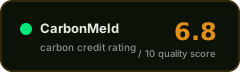
Score Breakdown
Integrity
verified Additionality is confirmed by the VVB (monitoring report, 2022-12-29).
missing Leakage treatment is inconsistent and no leakage deduction is evidenced in the extracted record (monitoring reports, 2021-04-13 vs 2022-12-29).
Transparency
verified VVB is identified and the monitoring period is clearly stated (monitoring report, 2022-12-29).
missing The extracted record lacks the claimed ER total and contains conflicting verified ER figures across documents.
Claim Safety
verified The project is explicitly not CORSIA-eligible, reducing aviation-claim channel risk (merged record).
missing Conflicting verified ER figures and unclear leakage handling increase over-crediting/greenwashing risk.
Documentation
verified Multiple core document types are available (PDD, validation, monitoring, issuance) with high extraction confidence.
missing Internal inconsistencies across official documents (ER totals, crediting period, safeguards statements) reduce document reliability.
Detailed Analysis
Integrity
The project applies ACM0002 with a project-specific baseline approach, but the timing of any baseline reassessment is not stated in the extracted record (monitoring report, 2022-12-29). Additionality is stated as confirmed by the VVB (monitoring report, 2022-12-29), supporting integrity. Leakage is a key weakness: one monitoring report indicates leakage was deemed negligible (monitoring report, 2021-04-13) while a later monitoring report indicates leakage was not addressed (monitoring report, 2022-12-29), and no leakage deduction is evidenced, which undermines robustness.
Transparency
The monitoring period (2021-03-01 to 2021-12-31) and the VVB name (EPIC Sustainability Services Private Limited) are clearly provided (monitoring report, 2022-12-29). However, the claimed ER total is not found in the extracted record, limiting cross-checking of issuance claims. Transparency is further weakened by conflicting verified ER figures across documents, which makes it difficult for third parties to reconcile results.
Claim Safety
The project is explicitly not CORSIA-eligible, which reduces the risk of high-profile aviation claims based on these credits (merged record). Nonetheless, over-crediting risk is elevated because the extracted record contains a major inconsistency in verified ER quantities across validation/verification documentation and because leakage is inconsistently justified (monitoring reports, 2021-04-13 vs 2022-12-29). CCP status is not stated in the extracted record, leaving an additional uncertainty for claims screening.
Documentation
The extracted record indicates a solid document set (PDD, validation report, monitoring report, and issuance) and uses eight documents with high extraction confidence, which supports completeness. No material findings or corrective actions are reported in the extracted record (monitoring report, 2022-12-29). However, multiple cross-document contradictions (ER totals, crediting period dates, and safeguards-related statements) indicate documentation consistency issues that reduce reliability despite the breadth of sources.
Overall
Overall quality is mid-range: additionality is VVB-confirmed and the project is not CORSIA-eligible, but contradictions materially weaken confidence. For leakage, the later monitoring report (2022-12-29) stating leakage was not addressed is privileged over the earlier monitoring report (2021-04-13) stating it was negligible, because it is more recent and suggests a gap rather than a justified conclusion. For safeguards (safeguards mention, grievance mechanism, benefit sharing, FPIC), the later monitoring report (2022-12-29) is privileged as the more recent operational account, but the fact these were absent in the PDD (2013-05-24) is treated as a reliability concern and scored down. For additionality test type, the validation report (2013-06-17) investment test is treated as the core additionality basis, with the later 'combined' description (monitoring report, 2022-12-29) viewed as inconsistent reporting rather than stronger evidence. For verified ERs, the 40,122 figure is used because it aligns with the monitoring period shown (2021-03-01 to 2021-12-31) and is more plausible for a partial-year period than 479,318; the magnitude of the discrepancy still drives a significant score penalty. For the crediting period, the validation report (2013-06-17) is privileged as the foundational registration document, but the mismatch with the monitoring report (2022-12-29) reduces confidence.
Audit Analysis
This is a VCS renewable electricity project using ACM0002 with additionality confirmed by the VVB and no reported material findings or corrective actions in the extracted record. However, key MRV and accounting elements show inconsistencies across documents (notably the verified ER volume and crediting period dates), and leakage treatment is unclear, which increases over-crediting and reliability risk.
Project Description
The Kirazlık Hydroelectric Power Plant project is a gravity dam located in southeastern Turkey, designed to regulate the outflow of the Alkumru Dam upstream and produce hydroelectric power with a total capacity of 46.11 MW. By generating 150,610 MWh of electricity per year, the project reduces CO2 emissions by an estimated 81,307 tonnes annually that would have otherwise been generated by grid-connected power plants.
Red Flags
- Large contradiction in verified emission reductions (40,122 vs 479,318) across validation/verification documents, raising MRV reliability concerns
- Leakage is inconsistently treated (described as not addressed vs deemed negligible) and no leakage deduction is clearly stated
- Crediting period dates conflict between the monitoring report and the validation report
- Safeguards/FPIC and grievance mechanism are described in later monitoring documentation but absent in the original PDD, suggesting inconsistent social risk documentation over time
Credit Vintages
| Issued | Retired | Available | ||
|---|---|---|---|---|
| 2013 | 1,722 | 1,722 | 0 | |
| 2014 | 41,888 | 41,888 | 0 | |
| 2015 | 63,255 | 63,255 | 0 | |
| 2016 | 91,311 | 0 | 91,311 | |
| 2017 | 63,727 | 2,101 | 61,626 | |
| 2018 | 33,259 | 7,040 | 26,219 | |
| 2019 | 104,673 | 0 | 104,673 | |
| 2020 | 73,494 | 0 | 73,494 | |
| 2021 | 5,989 | 0 | 5,989 | |
| Total | 479,318 | 116,006 | 363,312 |
Cosa migliorerebbe questo punteggio
- Provide a clear, consistent leakage assessment and explicitly state the leakage deduction (even if 0%) with justification in the monitoring/verification package.
- Publish or reference a reconciled ER table linking monitoring period generation, grid emission factor inputs, and issued/verified ERs to resolve the 40,122 vs 479,318 discrepancy.
- Clarify the official crediting period dates on the registry and align all project documents to the same dates.
Questi suggerimenti indicano quali prove pubbliche aggiuntive potrebbero migliorare il livello di confidenza di questa valutazione. Non garantiscono un punteggio futuro più alto.
Risk Indicators
VVB-confirmed additionality
Avoidance project; no reversal risk evidenced
Leakage handling inconsistent/unclear
Project-specific baseline; reassessment timing unclear
Safeguards/FPIC reported later but inconsistent with PDD
Not CORSIA-eligible; CCP status not stated
Where to buy
Marketplaces
+ Know where to buy this?
Listing multiple projects? Send us a CSV at [email protected].
⚑ Dispute this rating
Registry Documents
Sei il proprietario di questo progetto?
Correzione metadati (gratuita)
Nome, paese, marketplace o link errati? Segnalacelo.
Non modifica lo score.
[email protected] →Rivalutazione con nuovi documenti
Hai documentazione aggiornata non ancora inclusa? Puoi richiedere un nuovo run della pipeline con i nuovi input.
Invia Documenti →