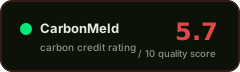
Livelihoods Chitetezo Mbaula Project
Score Breakdown
Integrity
verified Additionality is confirmed by the VVB using an investment test (monitoring report, 2023).
missing Baseline is project-specific and the timing of any baseline reassessment is not stated in the extracted record.
Transparency
verified Claimed and verified ERs match at 100,959 tCO2e for the monitoring period (monitoring report, 2023).
missing Usage monitoring is described as annual surveys, but no verified usage rate is provided in the extracted record (monitoring report, 2023).
Claim Safety
verified Leakage is quantified with a 5% deduction, which reduces over-crediting risk if consistently applied (monitoring report, 2023).
missing CORSIA eligibility and CCP status are not stated in the extracted record, and key accounting elements are contradictory across documents.
Documentation
verified Multiple core documents are evidenced (PDD, monitoring report, validation report, issuance) with high extraction confidence.
missing The verification/issuance cycle includes corrective action and numerous clarification requests, indicating documentation/QA friction (monitoring report, 2023).
Detailed Analysis
Integrity
The monitoring report (2023) indicates additionality was confirmed by the VVB using an investment test, supporting additionality robustness. Leakage is treated via a quantified approach with a 5% deduction in the monitoring report (2023), which is a positive integrity signal for clean-cooking projects where leakage can be material. The baseline is described as project-specific, and the timing of any baseline reassessment is not stated in the extracted record, which weakens baseline robustness over time. No reversal events are reported (monitoring report, 2023), but a buffer pool contribution is not stated in the extracted record (less relevant for this non-land-use project type).
Transparency
The monitoring report (2023) provides a clear monitoring period (2021-03-26 to 2022-09-30) and shows the same total emission reductions claimed and verified (100,959 tCO2e), which supports MRV consistency. The VVB is identified as CarbonCheck (CCIPL) in the extracted record, improving audit traceability. However, while usage monitoring is described as annual surveys (monitoring report, 2023), the verified usage rate is not stated in the extracted record, limiting transparency on a key driver of cookstove ERs. Registry-level eligibility flags (e.g., CORSIA) are not stated in the extracted record, reducing clarity for downstream buyers.
Claim Safety
Over-crediting risk is moderated by the presence of a quantified leakage approach and a 5% leakage deduction in the monitoring report (2023). Claim safety is weakened by uncertainty around the FNRB basis: the monitoring report (2023) indicates a national-default approach, while the validation report (2023) indicates a local-field approach, and this methodological choice can materially affect credited ERs. CORSIA eligibility and CCP status are not stated in the extracted record, so buyers cannot easily determine alignment with higher-integrity claim frameworks. The presence of corrective action and multiple clarification requests also suggests heightened diligence is needed when making public claims (monitoring report, 2023).
Documentation
The extracted record indicates a relatively complete document set (PDD, monitoring report, validation report, issuance) and a substantial number of documents used (12), with high extraction confidence. The monitoring report is recent (dated 2023-05-30) relative to the monitoring period end (2022-09-30), supporting recency. However, the monitoring/verification process included a corrective action request and 11 clarification requests (monitoring report, 2023), which signals that some elements required follow-up to reach final assurance. Some important fields remain unspecified in the extracted record (e.g., baseline reassessment timing, verified usage rate, CORSIA/CCP status).
Overall
Two contradictions reduce confidence in the reliability of key accounting inputs. For the FNRB method, I privilege the validation report (2023-05-31) over the monitoring report (2023-05-30) because validation typically defines the approved parameterization and methodological choices for the project design; the inconsistency still warrants a score penalty because it is unclear which approach was ultimately applied in calculations. For leakage justification, I privilege the monitoring report (2023-05-30) over the issuance record (2023-06-23) because the monitoring report is the technical MRV document that should contain the leakage quantification details; the issuance entry appearing to show leakage as not addressed suggests registry/summary-level incompleteness or a documentation mismatch. These inconsistencies increase over-crediting and claims risk, keeping the overall score in the mid range despite otherwise decent documentation coverage and VVB-confirmed additionality.
Audit Analysis
This VCS clean-cooking project shows reasonably strong core integrity signals, including VVB-confirmed additionality and a quantified leakage deduction. However, key parameters and narrative elements are inconsistent across documents (notably the FNRB method and whether leakage is addressed), which increases over-crediting and claims risk despite otherwise solid documentation coverage.
Project Description
Proponent: Livelihoods Fund SICAV SIF Protocol categories: Energy demand Protocols: VMR0006 Estimated annual GHG reductions: 262431 tCO2e Region: Africa Registration date: 2023-06-23
Red Flags
- Contradictory statements on the FNRB method between the monitoring report and validation report, which affects the emissions reduction calculation basis.
- Leakage treatment is inconsistent across documents (quantified in the monitoring report but shown as not addressed in issuance), raising reliability concerns.
Credit Vintages
| Issued | Retired | Available | ||
|---|---|---|---|---|
| 2021 | 100,959 | 26,074 | 74,885 | |
| Total | 100,959 | 26,074 | 74,885 |
Cosa migliorerebbe questo punteggio
- Resolve and publicly clarify the FNRB method actually applied (national default vs local field) and provide the supporting calculation sheets and parameter sources in the monitoring/verification package.
- Ensure leakage treatment is consistently documented across monitoring, verification, and issuance records (explicitly stating the 5% deduction and the quantification approach), and publish the verified usage rate results from the annual surveys.
Questi suggerimenti indicano quali prove pubbliche aggiuntive potrebbero migliorare il livello di confidenza di questa valutazione. Non garantiscono un punteggio futuro più alto.
Risk Indicators
VVB-confirmed investment test
No reversals reported (non-land-use)
Quantified but inconsistently recorded
Project-specific; reassessment timing unclear
FPIC and grievance mechanism documented
CORSIA/CCP status not stated
Where to buy
+ Know where to buy this?
Listing multiple projects? Send us a CSV at [email protected].
⚑ Dispute this rating
Sei il proprietario di questo progetto?
Correzione metadati (gratuita)
Nome, paese, marketplace o link errati? Segnalacelo.
Non modifica lo score.
[email protected] →Rivalutazione con nuovi documenti
Hai documentazione aggiornata non ancora inclusa? Puoi richiedere un nuovo run della pipeline con i nuovi input.
Invia Documenti →