The Clean Energy Cooking Initiative
Score Breakdown
Integrity
verified Additionality confirmed by the VVB (verification report, 2024-10-21) using a combined test
missing No buffer pool percentage stated and baseline reassessment not found; reversal events not addressed in available records
Transparency
verified VVB named (LGAI Technological Center, Applus+) and monitoring period and verified ERR are reported (verification report, 2024-10-21)
missing Evidence documents are listed as 'unknown' and minimum extraction confidence is low, reducing traceability
Claim Safety
verified Usage monitoring verified a 100% usage rate versus a 95% assumed rate (monitoring report / verification report), which is conservative for claims
missing Contradictions exist on FN/RB method (local field vs national default) and earlier very low assumed usage in an older document, raising over‑crediting concerns
Documentation
verified Recent verification report dated 2024-10-21 and 15 documents nominally used; all CARs/CLs reported were raised and closed
missing Min extraction confidence is low and evidence_docs are not clearly identified, indicating weak source transparency
Detailed Analysis
Integrity
The verification report (2024-10-21) confirms additionality using a combined test and the VVB (Applus+) approved the project, which supports integrity. The project uses a project-specific baseline methodology (VMR0006) and applies a quantified leakage deduction of 5% (monitoring/verification report). However, no buffer pool percentage is stated and baseline reassessment date is not found in the extracted record, and reversal events are not documented — these are weaknesses for permanence and baseline robustness.
Transparency
Key verification outputs are present: VVB name, monitoring period (2022-11-20 — 2023-04-30), and total emissions reductions claimed equal those verified (57,966), which is positive for MRV transparency. On the other hand, the extracted evidence documents are labeled 'unknown', minimum extraction confidence is low, and provenance for some inputs (e.g. earlier documents) is unclear, limiting traceability and reproducibility.
Claim Safety
The project appears relatively conservative on usage: an assumed usage rate of 95% versus a verified 100% suggests no upward bias in usage assumptions. Leakage was quantified and a 5% deduction applied. Nonetheless, contradictions in the free non‑renewable biomass approach (local field vs national default) and conflicting historical assumed usage values (1.825% in an older extract) introduce a risk of over‑crediting or unreliable baseline parameterisation.
Documentation
There is a recent verification report (2024-10-21) and 15 documents were reportedly used, and all corrective action requests were closed, which supports documentation completeness. However, the minimum extraction confidence is low and the evidence document list is not clearly identified, reducing confidence in the extraction and source linkage.
Overall
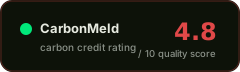
I privileged the most recent verification report (dated 2024-10-21) and the values it contains (e.g., local-field FN/RB method, crediting period 2022-11-20 — 2029-11-19, benefit sharing described as false in that report) because it is the latest authoritative VVB document in the merged facts. The merged_facts.contradictions list shows earlier documents with different values (FN/RB method earlier reported as national default on 2024-02-08; benefit sharing earlier reported as true on 2024-06-12; an older usage assumption of 1.825 from 2022-05-31; an earlier crediting period starting 2021-12-01). These contradictions reduce confidence and have been reflected by downward adjustments to transparency, documentation, and claim safety scores. Overall, the project is moderately robust (overall 5.6) but would benefit from clearer, retrievable source documents and resolution of the noted contradictions.
Audit Analysis
The project shows reasonably strong additionality confirmation and a quantified leakage deduction, but gaps remain in baseline reassessment, buffer treatment, and documentation confidence. Several contradictions across source documents and low extraction confidence reduce reliability of some inputs.
Project Description
Proponent: Multiple Proponents Protocol categories: Energy demand Protocols: VMR0006 Estimated annual GHG reductions: 136942 tCO2e Region: Asia Registration date: 2024-10-21
Red Flags
- Contradictory records on the free non‑renewable biomass method (local field vs national default) undermining baseline inputs
- Low extraction confidence and 'unknown' evidence documents — source traceability is weak
Credit Vintages
Nessuna emissione registrata sul registro.
Cosa migliorerebbe questo punteggio
- Publish or link the source evidence documents (full verification and monitoring reports) to resolve contradictions and raise extraction confidence
- Provide explicit buffer treatment and a documented baseline reassessment date; clarify the FN/RB method choice with supporting field data or national default justification
Questi suggerimenti indicano quali prove pubbliche aggiuntive potrebbero migliorare il livello di confidenza di questa valutazione. Non garantiscono un punteggio futuro più alto.
Risk Indicators
VVB-confirmed
buffer/risks unclear
quantified deduction
project baseline; reassessment missing
FPIC and grievance present
CORSIA/CCP status not stated
Where to buy
+ Know where to buy this?
Listing multiple projects? Send us a CSV at [email protected].
⚑ Dispute this rating
Sei il proprietario di questo progetto?
Correzione metadati (gratuita)
Nome, paese, marketplace o link errati? Segnalacelo.
Non modifica lo score.
[email protected] →Rivalutazione con nuovi documenti
Hai documentazione aggiornata non ancora inclusa? Puoi richiedere un nuovo run della pipeline con i nuovi input.
Invia Documenti →