The Russas Project
Score Breakdown
Integrity
verified Additionality is confirmed by the VVB and assessed via a common-practice test (validation/verification documentation referenced in the extracted record).
missing Baseline is project-specific and the timing of baseline reassessment is not stated in the extracted record; reversal monitoring/treatment is also inconsistent across documents.
Transparency
verified A recent monitoring report (dated 2023-09-13) provides a clear monitoring period (2018-01-01 to 2020-12-31) and a verified ER volume of 174,227 tCO2e.
missing The claimed ER total is not found in the extracted record, and several key quantified parameters (e.g., leakage deduction percent) are missing despite being referenced as quantified.
Claim Safety
verified The project is explicitly not CORSIA-eligible, reducing aviation-claim and some double-claiming exposure.
missing Over-crediting risk remains due to missing claimed ER figures and incomplete leakage quantification in the extracted record, plus multiple cross-document contradictions.
Documentation
verified A relatively large document set was used (69 documents) including PDD, validation report, monitoring report, and issuance records.
missing Extraction confidence is only medium and several core safeguards fields contradict between the validation report and the monitoring report, reducing confidence in document consistency.
Detailed Analysis
Integrity
The project is an avoidance REDD activity under VM0007 with additionality confirmed by the VVB using a common-practice test, which supports the additionality case. Permanence risk management is mixed: a buffer pool contribution is stated, but the percentage is inconsistent across documents (10% in a monitoring report versus 15% in an older unidentified document). Reversal events are not consistently handled in the record, with a monitoring report indicating reversals were not addressed while the validation report states none were reported, which weakens confidence in non-permanence monitoring. Leakage is described as quantified in the 2023 monitoring report, but the actual leakage deduction percentage is not found in the extracted record, limiting assurance that leakage was conservatively applied.
Transparency
The monitoring report dated 2023-09-13 clearly states the monitoring period (2018-01-01 to 2020-12-31) and provides a verified emissions reduction figure of 174,227 tCO2e. However, the claimed emissions reductions are not found in the extracted record, making it harder to reconcile what was requested versus what was verified. Leakage is said to be quantified in the monitoring report, but the absence of the leakage deduction percentage in the extracted record reduces MRV transparency. The presence of issuance documentation in the evidence list supports registry traceability, but contradictions across documents reduce overall transparency confidence.
Claim Safety
The project is explicitly not CORSIA-eligible, which lowers the risk of high-impact aviation-related claims and some double-claiming concerns. Nonetheless, over-crediting risk cannot be fully ruled out because the extracted record lacks the claimed ER total and does not provide the leakage deduction percentage even though leakage is described as quantified in the monitoring report (2023-09-13). The baseline is project-specific and baseline reassessment timing is not found in the extracted record, which can increase discretion and perceived over-crediting risk. CCP status is not found in the extracted record, so buyers cannot rely on that label as an external quality screen.
Documentation
The extracted record indicates a substantial documentation base (69 documents) including a PDD, validation report, monitoring report, and issuance records, which is a positive for completeness. However, minimum extraction confidence is only medium, implying some limitations in readability or extraction quality. Several safeguards-related items (FPIC, grievance mechanism, benefit sharing, and safeguards mention) conflict between the validation report (2019-05-06) and the monitoring report (2023-09-13), indicating either evolving practices or inconsistent reporting. These inconsistencies reduce confidence that the documentation set is internally coherent.
Overall
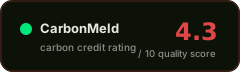
Overall quality is moderate: additionality is VVB-confirmed and the project is not CORSIA-eligible, but multiple contradictions reduce confidence in key risk controls. For the buffer pool percentage, the more recent monitoring report value (10% dated 2023-03-06) is privileged over the older, unidentified 2017 document (15%) because it is more recent and comes from a known document type; the contradiction still lowers integrity and documentation scores. For reversal events, the monitoring report stating reversals were "not addressed" is treated as the more conservative and therefore privileged interpretation over the validation report’s "none reported" statement, and this reduces integrity. For leakage, the 2023 monitoring report’s statement that leakage was quantified is privileged over the 2014 PDD’s lack of leakage treatment due to recency and monitoring-stage specificity, but the missing leakage deduction percentage in the extracted record keeps integrity/transparency/claim-safety scores constrained. For safeguards (FPIC, grievance mechanism, benefit sharing, safeguards mention), the monitoring report’s affirmative statements are privileged as more recent operational evidence, but the direct contradiction with the validation report indicates reporting reliability issues and therefore lowers documentation and transparency.
Audit Analysis
This is a VCS REDD avoidance project using VM0007 with VVB-confirmed additionality and a stated buffer contribution, which supports basic integrity. However, key risk controls are inconsistently documented across project documents (buffer percentage, reversal treatment, and safeguards), and leakage is said to be quantified but the actual leakage deduction is not provided in the extracted record.
Project Description
The Russas Project is a tropical forest conservation project located in Acre, Brazil, that aims to reduce deforestation and its associated greenhouse gas emissions. The project is being developed and registered under the Verified Carbon Standard (VCS) and the Climate, Community & Biodiversity Standards (CCBS). The project is implemented in and around a privately-owned property in the State of Acre, Brazil. Project activities are funded by payments for verified emission reductions generated by the project. **Environmental Benefits** The Russas Project is designed to mitigate deforestation and preserve the rich biodiversity of the Amazon rainforest. By protecting the forest, the project helps to maintain critical ecosystem services such as water cycling, filtration, and storage, nutrient recycling, soil quality enhancement, and provision of food and habitat for wildlife. The project also contributes to climate change mitigation by reducing greenhouse gas emissions from deforestation. The project has successfully reduced deforestation in the project area, leading to the preservation of biologically diverse habitats. The project proponents have also conducted biodiversity studies utilizing motion-sensitive wildlife cameras to monitor the presence of various species, including endangered ones. **Social and Community Benefits** The Russas Project is committed to generating sustainable economic opportunities for the local communities and implementing social projects that improve their livelihoods. The project has engaged in extensive community outreach and education, providing agricultural extension training to help local farmers increase productivity on their existing lands and reduce the pressure to expand into the forest. The project has also assisted communities in obtaining land tenure and has made efforts to improve healthcare services, including building and renovating health clinics. The project proponents have also distributed dental kits and mosquito nets, a
Red Flags
- Buffer pool contribution is inconsistent across documents (10% in a monitoring report vs 15% in an older, unidentified document), raising reliability concerns for permanence risk management.
- Reversal events are inconsistently treated ("none reported" in the validation report vs "not addressed" in a monitoring report), which weakens confidence in non-permanence monitoring.
- Leakage is described as quantified in the 2023 monitoring report, but the leakage deduction percentage is not found in the extracted record and the PDD did not address leakage.
Credit Vintages
| Issued | Retired | Available | ||
|---|---|---|---|---|
| 2011 | 140,450 | 140,450 | 0 | |
| 2014 | 162,177 | 162,177 | 0 | |
| 2015 | 179,634 | 176,276 | 3,358 | |
| 2016 | 184,219 | 34,007 | 150,212 | |
| 2017 | 174,227 | 121,266 | 52,961 | |
| 2018 | 283,475 | 150,169 | 133,306 | |
| 2019 | 115,967 | 48,728 | 67,239 | |
| 2020 | 100,734 | 35,081 | 65,653 | |
| Total | 1,340,883 | 868,154 | 472,729 |
Cosa migliorerebbe questo punteggio
- Disclose and reconcile the exact leakage deduction applied (percent and calculation) in the monitoring/verification package and ensure it is consistently reflected across PDD and monitoring reports.
- Provide a clear, consistent statement of buffer pool contribution and reversal monitoring outcomes for the monitoring period, with cross-references to registry/buffer account evidence and any non-permanence risk updates.
Questi suggerimenti indicano quali prove pubbliche aggiuntive potrebbero migliorare il livello di confidenza di questa valutazione. Non garantiscono un punteggio futuro più alto.
Risk Indicators
VVB-confirmed common-practice test
Buffer stated but reversal treatment inconsistent
Leakage said quantified; deduction not evidenced here
Project-specific baseline; reassessment timing unclear
Safeguards/FPIC reported but contradict validation
Not CORSIA-eligible; CCP status not stated
Where to buy
Marketplaces
+ Know where to buy this?
Listing multiple projects? Send us a CSV at [email protected].
⚑ Dispute this rating
Registry Documents
issuance
monitoring
- CCB_MONIT_REP_ENG_1112_01JAN2017_31DEC2017.pdf
- MONIT_REP_1112_01JAN2017_31DEC2017.pdf
- MONIT_REP_1112_17MAR2011_31DEC2013.pdf
- Russas Project's CCB-VCS 2018-2020 Monitoring Report (9-13-2023) (Clean).pdf
- MONIT_REP_1112_01JAN2014_31DEC2016.PDF
- Russas Project's CCB-VCS 2018-2020 Monitoring Report (9-1-2021).pdf
- +3 more
Other
pdd
validation
- VERIF_STA_1112_01JAN2014_31DEC2016.pdf
- CCBA_VERIF_STA_1112_17MAR2011_31DEC2013.pdf
- VERIF_STA_1112_01JAN2017_31DEC2017.pdf
- Russas Project's New Verra Registry Communications Agreement-multiple-PPs (Fully Signed).pdf
- CCBA_VALID_REP_1112_19MAR2014.pdf
- CCB_VERIF_STA_1112_01JAN2017_31DEC2017.pdf
- +17 more
Sei il proprietario di questo progetto?
Correzione metadati (gratuita)
Nome, paese, marketplace o link errati? Segnalacelo.
Non modifica lo score.
[email protected] →Rivalutazione con nuovi documenti
Hai documentazione aggiornata non ancora inclusa? Puoi richiedere un nuovo run della pipeline con i nuovi input.
Invia Documenti →