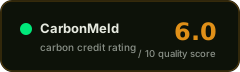
Up Energy Improved Cookstoves Programme, Uganda – CPA No 043 supported by Republic of Korea
Score Breakdown
Integrity
verified Additionality was confirmed by the VVB, and the project uses a combined additionality test under AMS-II.G Version 05.0.
missing Permanence is not fully evidenced because reversal events are marked as not addressed and no buffer pool share is stated.
Transparency
verified The monitoring period is stated, the VVB is named, and the report includes quantified usage and leakage parameters.
missing Total ER claims and verified totals are not found in the extracted record, and one key document was only medium-confidence extraction.
Claim Safety
verified Leakage is at least quantified, with a leakage deduction of 0.95% and a stated quantified justification.
missing The baseline is project-specific rather than clearly standardized, and the record contains contradictions on leakage justification and usage monitoring.
Documentation
verified Multiple evidence documents were used, including a monitoring report and stakeholder consultation material, and safeguards are explicitly mentioned.
missing The extraction confidence is only medium, and several important fields are missing or inconsistent across documents, including the crediting period.
Detailed Analysis
Integrity
The monitoring report states that additionality was confirmed by the VVB, which supports the project’s core environmental integrity. Leakage is quantified with a 0.95% deduction, and the report lists no unresolved corrective actions, but reversal events are marked as not addressed and no buffer pool percentage is available. The baseline is project-based, and the baseline was last reassessed in 2024, which helps, but permanence and long-term robustness remain only moderately supported.
Transparency
The record identifies the VVB, the monitoring period, the usage monitoring approach, and the quantified leakage treatment, which is helpful for traceability. At the same time, total ER claimed and verified totals are not found in the extracted record, limiting public-facing completeness. The extraction confidence is medium rather than high, so some documentation quality concerns remain.
Claim Safety
Claim safety is helped by the quantified leakage deduction and the verified usage rate of 90.92%, which suggests the project is not relying on extreme assumptions. However, the baseline is project-specific, and the record shows contradictions on usage monitoring and leakage justification, which raises over-crediting risk. The project is not clearly shown to be CORSIA-eligible or CCP-approved, so dual-market claim risk cannot be ruled out from the available evidence.
Documentation
The evidence base includes a monitoring report, stakeholder consultation material, and other extracted documents, and the project also reports FPIC, a grievance mechanism, and benefit sharing. Still, the minimum extraction confidence is medium, and several fields are missing or not stated, including buffer pool coverage and total ER figures. The crediting period also conflicts across documents, which weakens documentation reliability.
Overall
Overall, this is a mid-quality project record with some solid strengths, especially VVB-confirmed additionality and quantified leakage treatment. I privileged the more recent monitoring-report values for usage monitoring and leakage treatment because they are closer to the monitoring period, but I discounted confidence because the contradictions show the record is not fully consistent. The conflicting crediting-period entries and benefit-sharing descriptions are material reliability issues, so the score is held below a strong-approval range.
Audit Analysis
This is a reasonably documented cookstove project with VVB-confirmed additionality, a quantified leakage deduction, and no reported reversal events. However, the record has several reliability issues, including contradictions on usage monitoring, leakage justification, benefit sharing, and crediting period, which reduce confidence in the claims.
Project Description
Developer: UpEnergy Group Type: Energy Efficiency - Domestic Size: Small Scale Methodology: AMS-II.G. Energy Efficiency Measures in Thermal Applications of Non-Renewable Biomass Crediting period: 2020-01-07 → 2025-01-06 Estimated annual credits: 41186 tCO2e SDGs: Goal 12: Responsible Production and Consumption, Goal 5: Gender Equality, Goal 7: Affordable and Clean Energy, Goal 13: Climate Action, Goal 1: No Poverty, Goal 3: Good Health and Well-Being, Goal 8: Decent Work and Economic Growth, Goal 15: Life On Land
Red Flags
- The documents conflict on how usage was monitored, with an annual survey in the monitoring report but self-reporting in an earlier record.
- The crediting period and benefit-sharing description are inconsistent across documents, and the project has no reported buffer pool information.
Credit Vintages Exhausted
| Issued | Retired | Available | ||
|---|---|---|---|---|
| 2021 | 24,804 | 24,804 | 0 | |
| Total | 24,804 | 24,804 | 0 |
Cosa migliorerebbe questo punteggio
- Publish a reconciled monitoring package that resolves the usage-monitoring, leakage, benefit-sharing, and crediting-period contradictions.
- Disclose verified issuance totals, buffer pool treatment, and any registry/market eligibility status to reduce double-claim and permanence uncertainty.
Questi suggerimenti indicano quali prove pubbliche aggiuntive potrebbero migliorare il livello di confidenza di questa valutazione. Non garantiscono un punteggio futuro più alto.
Risk Indicators
VVB-confirmed combined test
no buffer pool stated
quantified 0.95% deduction
project baseline, reassessed in 2024
FPIC and grievance mechanism present
CORSIA/CCP status not stated
Where to buy
+ Know where to buy this?
Listing multiple projects? Send us a CSV at [email protected].
⚑ Dispute this rating
Sei il proprietario di questo progetto?
Correzione metadati (gratuita)
Nome, paese, marketplace o link errati? Segnalacelo.
Non modifica lo score.
[email protected] →Rivalutazione con nuovi documenti
Hai documentazione aggiornata non ancora inclusa? Puoi richiedere un nuovo run della pipeline con i nuovi input.
Invia Documenti →