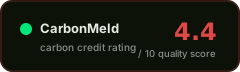
VPA - Spouts - 2
Score Breakdown
Integrity
verified Additionality was confirmed by the VVB using a barrier test, which supports the project’s core additionality claim.
missing Permanence is weakly documented because no buffer pool share is stated and reversal events are not addressed in the monitoring report.
Transparency
verified The monitoring report provides a defined monitoring period and identifies the annual survey approach for usage monitoring.
missing Key disclosure gaps remain because the verified and claimed emission reductions are not stated, and the VVB name is not found in the extracted record.
Claim Safety
verified The project uses a quantified leakage approach and reports a national default method for non-renewable biomass, which is better than an unbounded baseline assumption.
missing Claim safety is weakened because the assumed usage rate of 60% differs from the verified 82%, and the record does not state CORSIA or CCP status.
Documentation
verified The record includes five extracted documents and reports no material findings or corrective actions in the monitoring report.
missing Extraction confidence is only medium, and the contradictions on usage monitoring and crediting period suggest the document set is not fully consistent.
Detailed Analysis
Integrity
The monitoring report dated 2020-10-14 shows additionality was confirmed by the VVB through a barrier test, which is a meaningful positive signal. However, baseline reassessment timing is not stated, the buffer pool percentage is missing, and reversal events are marked as not addressed, so permanence and baseline robustness are only moderately supported. Leakage is described as quantified, but the actual deduction percentage is not found in the extracted record.
Transparency
The monitoring report covers 2019-09-01 to 2020-08-31 and says usage was monitored through an annual survey, which helps traceability. Still, the verified and claimed emission reduction totals are not stated, the VVB name is not found, and CORSIA eligibility is not stated, all of which limit public-facing transparency. The medium extraction confidence also suggests some source material was not fully clear.
Claim Safety
Claim safety is helped by the use of a project baseline under TPDDTEC and a quantified leakage treatment, plus a national default approach for non-renewable biomass with a verified usage rate of 82%. That said, the assumed usage rate of 60% differs materially from the verified 82%, which raises over-crediting concerns. CORSIA eligibility and CCP status are not stated, so dual-market claim risk cannot be ruled out from the available record.
Documentation
The extracted set includes five documents, and the monitoring report reports no material findings and no corrective actions required. Even so, the VVB name is missing, extraction confidence is only medium, and the record contains contradictions on the usage monitoring method and crediting period. I privileged the later monitoring report dated 2020-10-14 over the earlier 2017-07 reference because it is more recent and likely supersedes the earlier project documentation, but the inconsistency still lowers reliability.
Overall
Overall, this is a mid-quality file with some real strengths in additionality and leakage treatment, but important gaps in permanence, disclosure completeness, and claim safety. I privileged the 2020-10-14 monitoring report over the earlier 2017-07 references because it is more recent and specific, yet the contradictions on usage monitoring and crediting period still indicate documentation reliability issues. The integrity score is kept above the low range because additionality is VVB-confirmed, but the missing permanence and baseline details prevent a stronger result.
Audit Analysis
The project has some positive integrity signals, including VVB-confirmed additionality and a quantified leakage approach, but key permanence and baseline details are incomplete. Transparency is limited by missing verification totals, missing registry eligibility status, and contradictions in the monitoring record that reduce confidence in the documentation.
Project Description
Developer: Believe Green LLC Type: Energy Efficiency - Domestic Size: Micro Scale Methodology: Not provided Crediting period: 2017-09-01 → 2022-08-31 Estimated annual credits: 10000 tCO2e SDGs: Goal 13: Climate Action, Goal 12: Responsible Production and Consumption, Goal 6: Clean Water and Sanitation
Red Flags
- Reversal risk is not addressed: no buffer pool percentage is stated and reversal events are marked as not addressed.
- The record contains contradictions on the usage monitoring method and crediting period, which weakens confidence in the reported monitoring history.
Credit Vintages Exhausted
| Issued | Retired | Available | ||
|---|---|---|---|---|
| 2017 | 2,119 | 2,119 | 0 | |
| 2018 | 9,728 | 9,728 | 0 | |
| 2019 | 9,610 | 9,610 | 0 | |
| 2020 | 5,685 | 5,685 | 0 | |
| Total | 27,142 | 27,142 | 0 |
Cosa migliorerebbe questo punteggio
- Publish the verified and claimed emission reduction totals, the VVB name, and the exact leakage deduction used in the issuance calculation.
- Document buffer pool treatment, reversal risk management, FPIC status, and resolve the contradictions on usage monitoring and crediting period with a clear document hierarchy.
Questi suggerimenti indicano quali prove pubbliche aggiuntive potrebbero migliorare il livello di confidenza di questa valutazione. Non garantiscono un punteggio futuro più alto.
Risk Indicators
VVB-confirmed barrier test
No buffer pool stated
Quantified but deduction missing
Project baseline, reassessment missing
Grievance and safeguards noted, FPIC not stated
CORSIA/CCP status not stated
Where to buy
+ Know where to buy this?
Listing multiple projects? Send us a CSV at [email protected].
⚑ Dispute this rating
Sei il proprietario di questo progetto?
Correzione metadati (gratuita)
Nome, paese, marketplace o link errati? Segnalacelo.
Non modifica lo score.
[email protected] →Rivalutazione con nuovi documenti
Hai documentazione aggiornata non ancora inclusa? Puoi richiedere un nuovo run della pipeline con i nuovi input.
Invia Documenti →