Yazi 1.13 MW HEPP
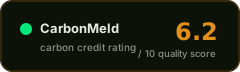
Score Breakdown
Integrity
verified Additionality was confirmed by the VVB, and the project uses a combined test rather than relying on an unverified assertion.
missing The monitoring report required corrections for meter malfunction impacts and date errors, which weakens confidence in the quantified reductions.
Transparency
verified The project has a named VVB and a long monitoring period documented in the monitoring report.
missing Claimed versus verified emission-reduction totals are not stated in the extracted record, and the monitoring report contains data-quality issues.
Claim Safety
verified Leakage is treated with a quantified deduction of 0%, which is at least explicitly addressed in the monitoring report.
missing The baseline is project-specific rather than a recently reassessed standardized baseline, and key usage and grid-factor inputs are not stated.
Documentation
verified Multiple evidence documents were used, including the monitoring report, validation report, PDD, and issuance material.
missing The extraction confidence is only medium, and the monitoring report itself lists several corrective actions, indicating incomplete documentation quality.
Detailed Analysis
Integrity
The validation and monitoring materials indicate additionality was confirmed by the VVB, and the monitoring report records a quantified leakage deduction of 0%. However, the monitoring report also says the impact and duration of the main meter malfunction were not fully included in the quantification, and it required corrective actions on that point. The baseline is project-specific, and reversal events are noted as not addressed, so permanence and baseline robustness are only moderate.
Transparency
The project has a named verifier, Carbon Check India Private Limited, and the monitoring period is clearly stated in the monitoring report. That said, the extracted record does not provide verified versus claimed emission totals, and several operational inputs such as usage monitoring method and grid emission factor are not stated. The monitoring report also contains date inconsistencies, which reduces reporting clarity.
Claim Safety
Claim safety is weakened by the project-specific baseline and the absence of key quantified inputs such as usage rates and grid emission factors in the extracted record. On the positive side, the monitoring report states a quantified leakage treatment rather than leaving leakage unaddressed. Because the record does not show CORSIA or CCP status, dual-claim risk cannot be ruled out from the extracted facts alone.
Documentation
The record draws on multiple document types, including the monitoring report, validation report, PDD, and issuance material, which is a positive sign. Still, the extraction confidence is only medium, and the monitoring report itself lists several corrective actions, including meter-malfunction clarification, date corrections, and title confirmation. The crediting period is also older than the monitoring report, so the documentation is not especially fresh.
Overall
I privileged the 2022 monitoring report over the older 2011 validation report where the two conflict, because it is more recent and directly relevant to monitored issuance; that means I treated the additionality test as combined rather than investment-only. I also privileged the monitoring report’s statement that leakage was quantified over the validation report’s earlier indication that leakage was not addressed, but this is tempered by the fact that the same monitoring report contains material data-quality issues. The benefit-sharing contradiction is less central to credit integrity, but it still signals inconsistency across documents and lowers reliability.
Audit Analysis
This project has some positive integrity signals, including VVB-confirmed additionality and a quantified leakage treatment, but the evidence is weakened by unresolved monitoring issues and missing key parameters. The monitoring report also flags meter malfunction, incorrect emission-reduction dates, and a project-title mismatch, which reduce confidence in the reported results.
Project Description
Proponent: Elestas Elektrik Uretim A.S. Protocol categories: Energy industries (renewable/non-renewable sources) Protocols: AMS-I.D. Estimated annual GHG reductions: 2825 tCO2e Region: Middle East Registration date: 2020-06-04
Red Flags
- The monitoring report says the main meter malfunction was not fully explained in the quantification, and corrective actions were required.
- There is a project-title mismatch between documents and the registry, plus incorrect dates in the emission-reduction tables.
Credit Vintages
| Issued | Retired | Available | ||
|---|---|---|---|---|
| 2016 | 2,234 | 0 | 2,234 | |
| 2017 | 1,915 | 0 | 1,915 | |
| 2018 | 1,716 | 0 | 1,716 | |
| 2019 | 1,386 | 0 | 1,386 | |
| Total | 7,251 | 0 | 7,251 |
Cosa migliorerebbe questo punteggio
- Publish a corrected monitoring report that resolves the meter malfunction, date errors, and project-title mismatch, with a clear explanation of how the malfunction affected quantified reductions.
- Disclose verified versus claimed emission totals, usage-monitoring details, and registry/eligibility status to reduce uncertainty around over-crediting and double-claim risk.
Questi suggerimenti indicano quali prove pubbliche aggiuntive potrebbero migliorare il livello di confidenza di questa valutazione. Non garantiscono un punteggio futuro più alto.
Risk Indicators
VVB-confirmed combined test
No reversal treatment stated
Quantified 0% deduction
Project baseline, reassessment not stated
FPIC and grievance mechanism present
CORSIA/CCP status not stated
Where to buy
+ Know where to buy this?
Listing multiple projects? Send us a CSV at [email protected].
⚑ Dispute this rating
Sei il proprietario di questo progetto?
Correzione metadati (gratuita)
Nome, paese, marketplace o link errati? Segnalacelo.
Non modifica lo score.
[email protected] →Rivalutazione con nuovi documenti
Hai documentazione aggiornata non ancora inclusa? Puoi richiedere un nuovo run della pipeline con i nuovi input.
Invia Documenti →