REDD+ JIGRANTU Project
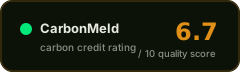
Score Breakdown
Integrity
verified The validation/verification documentation indicates additionality was confirmed by the VVB (validation report).
missing Baseline method, leakage treatment, and buffer/non-permanence provisions were not found in the extracted record (PDD/monitoring report).
Transparency
verified A named VVB (ICONTEC) and a clearly stated monitoring period (2019-02-01 to 2022-12-31) are provided (monitoring report).
missing Claimed vs verified ER totals and key MRV parameters (baseline and leakage quantification) were not found in the extracted record.
Claim Safety
inferred CORSIA and CCP status were not found in the extracted record, leaving eligibility/label-claim risk unclear.
missing Missing baseline and leakage quantification increases over-crediting risk for an avoidance (REDD+) project (PDD/monitoring report not showing these fields in the extracted record).
Documentation
verified Three core document types are available (PDD, validation report, monitoring report) with high extraction confidence.
missing Despite document availability, several critical quantitative fields (ER totals, baseline, leakage, buffer) were not found in the extracted record.
Detailed Analysis
Integrity
The validation report indicates additionality was confirmed by the VVB, which supports the additionality case. However, the baseline approach and any baseline reassessment timing were not found in the extracted record (PDD/validation/monitoring), which is a major integrity gap for REDD+ crediting. Leakage treatment (deduction and justification) and non-permanence risk management (buffer pool or equivalent) were also not found in the extracted record, limiting confidence in net credited reductions and permanence controls.
Transparency
The monitoring report (dated 2024-08-26) clearly states the monitoring period as 2019-02-01 to 2022-12-31 and identifies the VVB as ICONTEC. No claimed or verified emission reduction totals were found in the extracted record, preventing a basic cross-check of MRV outputs. Key methodological disclosures that typically enable third-party scrutiny—baseline method and leakage quantification—were also not found in the extracted record.
Claim Safety
Because the baseline method and leakage approach were not found in the extracted record, there is elevated uncertainty around over-crediting risk for an avoidance (REDD+) project. CORSIA eligibility and CCP status were not found in the extracted record, so buyers cannot reliably infer whether additional aviation/CCP-related claims are appropriate. The absence of extracted claimed/verified ER totals further increases the risk of miscommunication or unsupported marketing claims about delivered outcomes.
Documentation
The extracted record includes a PDD, validation report, and monitoring report (three documents) and the minimum extraction confidence is high, which supports document reliability. The monitoring report is recent (2024-08-26) and covers a multi-year monitoring period. However, several critical quantitative items (claimed/verified ER totals, baseline method, leakage deduction/justification, buffer pool) were not found in the extracted record despite these documents being present, indicating completeness gaps in what was captured or disclosed.
Overall
No contradictions were listed in the extracted record, so scores were not adjusted for inter-document discrepancies. The overall score is primarily constrained by missing core quantifications (baseline, leakage, buffer/non-permanence, and ER totals) that are central to REDD+ credit integrity and safe claims. Strengths are the presence of core documents, high extraction confidence, VVB-confirmed additionality, and stated safeguards (FPIC and grievance mechanism), but these do not fully offset the over-crediting and permanence uncertainty.
Audit Analysis
The project has some core integrity elements documented, including VVB-confirmed additionality and stated social safeguards (FPIC and a grievance mechanism). However, key quantifications that underpin credit quality—baseline approach, leakage treatment, buffer/non-permanence provisions, and verified ERs—were not found in the extracted record, which increases over-crediting and claim-risk uncertainty.
Project Description
The JIGRANTU REDD+ Project is being developed in the Colombian Pacific within the boundaries of the Community Councils of La Grande (13,252 ha), Río Jiguamiandó (51,504 ha) and Turriquitadó (9,256 ha) with a total of 74,012 ha of which 68,899 ha correspond to forest eligible for the project. The main objective of the project is to environmentally and culturally conserve the territory of the councils through the consolidation of self-government, strengthening of traditional knowledge, actions for sustainable development, and monitoring and control of the territory to improve the quality of life of the communities that inhabit it during the duration of the project (30 years).
Red Flags
- Baseline approach and any baseline reassessment timing were not found in the extracted record (PDD/validation/monitoring), limiting confidence in avoided-deforestation additionality and crediting levels.
- Leakage deduction and justification were not found in the extracted record, despite leakage being a material risk for REDD+ projects.
- Non-permanence risk management (buffer pool or equivalent) and any reversal reporting were not found in the extracted record.
- No claimed or verified emission reductions were found in the extracted record for the stated monitoring period (2019–2022).
- Leakage not addressed in project documentation
- Buffer pool size not disclosed in available documents
Credit Vintages
Nessuna emissione registrata sul registro.
Il marketplace dichiara i vintage: 2019, 2020, 2021, 2022 (non verificato).
Cosa migliorerebbe questo punteggio
- Disclose (or extract) the baseline method and the date/results of the most recent baseline reassessment, with enough detail to reproduce key baseline assumptions.
- Provide quantified leakage assessment (justification plus any deduction) and clearly document non-permanence risk management (buffer pool percentage or equivalent) and any reversal monitoring outcomes.
- Publish the claimed and verified emission reductions for the 2019–2022 monitoring period and reconcile them to registry issuance/retirement records.
Questi suggerimenti indicano quali prove pubbliche aggiuntive potrebbero migliorare il livello di confidenza di questa valutazione. Non garantiscono un punteggio futuro più alto.
Risk Indicators
VVB-confirmed additionality
Buffer/reversal info not found
Leakage treatment not found
Baseline method not found
FPIC and grievance mechanism documented
CORSIA/CCP status not found
Where to buy
Marketplaces
+ Know where to buy this?
Listing multiple projects? Send us a CSV at [email protected].
⚑ Dispute this rating
Sei il proprietario di questo progetto?
Correzione metadati (gratuita)
Nome, paese, marketplace o link errati? Segnalacelo.
Non modifica lo score.
[email protected] →Rivalutazione con nuovi documenti
Hai documentazione aggiornata non ancora inclusa? Puoi richiedere un nuovo run della pipeline con i nuovi input.
Invia Documenti →