Regenerative Agriculture in the USA
Score Breakdown
Integrity
inferred Claims direct 3' soil sampling for quantification, but no audit report to confirm uncertainty, sampling protocol, or crediting calculations
missing Additionality, baseline, permanence buffer, and leakage deductions not evidenced in public documents
Transparency
missing No linked registry page/ledger with serials, issuance, and retirement records; only marketplace narrative provided
inferred Standard is named, but underlying methodology and governance are not accessible from provided evidence
Claim Safety
missing Double-claim/double-counting controls and retirement rules cannot be verified without a registry ledger/serial numbers
inferred Marketed as “removal” with durability claims, but no public methodology/verification to substantiate durability and net removal
Documentation
missing No public PDD/methodology, monitoring report, or third-party verification report provided
missing No dates, verifier/certifier identity, or audit findings disclosed
Detailed Analysis
Integrity
Based on marketplace claims only, the project uses regenerative grazing with soil carbon measured via “actual 3' deep soil samples,” which is directionally stronger than purely modeled estimates, but no verification report is provided to confirm sampling design, uncertainty, or crediting calculations. Additionality is not demonstrated (no investment/barrier/common-practice evidence), and the baseline/counterfactual for soil carbon changes is not disclosed. Permanence is a key risk for soil carbon (reversals from drought, management change, or land conversion), and the listing’s “thousands of years” claim is not substantiated with a buffer/insurance mechanism. Leakage (e.g., displacement of grazing or production) is not described or quantified.
Transparency
No registry record, issuance/retirement ledger, or downloadable project documents are linked; only a marketplace narrative is available. The standard/registry (“Regen Standard / Regenerative Standard”) is named, but there is no public documentation trail in the provided evidence to independently audit claims. As a result, a buyer cannot easily verify volumes, vintages, or retirement status from primary sources.
Claim Safety
With no accessible registry ledger, the double-counting/double-issuance risk cannot be assessed, and buyer claim guidance (retirement, serial numbers, exclusivity) is not verifiable. CCP/ICVCM eligibility is not evidenced, and no Article 6 authorization/corresponding adjustment information is provided (not required, but relevant for claim clarity). The credits are marketed as “carbon removal,” but without methodology and verification details, the strength of the removal claim and durability characterization is uncertain.
Documentation
No PDD, methodology document, monitoring report, or third-party verification statement is provided in the marketplace evidence. The listing mentions certification and verification via soil sampling, but does not provide the certifier/VVB name, report dates, or audit findings. Document recency and monitoring frequency cannot be checked.
Overall
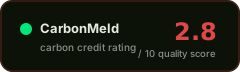
Overall score is constrained by marketplace-only evidence and the absence of auditable documentation. The main potential strength is the stated use of direct soil sampling and a named standard, but these are not independently verifiable here. The biggest drivers of the low score are (1) missing public verification/monitoring documentation and (2) unaddressed soil-carbon permanence and baseline/additionality uncertainty. Confidence is low until a registry record and third-party verification/monitoring reports are made publicly accessible.
Audit Analysis
Evidence scope is marketplace_only (ClimateTrade listing metadata only), so confidence is low and scores are conservative. The listing asserts soil sampling and certification under a “Regenerative Standard,” but without public PDD/methodology, monitoring, or third-party verification reports, additionality, baseline conservatism, permanence, and leakage cannot be validated.
Project Description
Are you interested in purchasing high-quality carbon removal credits with water, ecosystem, and community co-benefits? Grassroots Carbon combines cutting-edge science and climate technology with ranchers regenerating America’s grasslands to help your company achieve its climate targets. Nature has the power to remove gigatons of carbon dioxide from the atmosphere today - and healthy soil underpins nature’s ability to do so. America’s grasslands have the capacity to store a quarter of all US carbon dioxide emissions and deliver impactful co-benefits. Carbon sequestered in grassland root systems can remain in the soil for thousands of years. It is the most effective atmospheric carbon removal solution, with incredible impacts far beyond just carbon, including grassland ecology regeneration, soil health, soil water storage, and biodiversity. Grassroots Carbon can tap into its network of thousands of ranchers representing 4 million acres across the US to remove tons of CO2 from the atmosphere at scale every year. How the program works: 1. Land stewards commit to regenerative ranching practices to sequester greater amounts of soil carbon 2. They receive training and free PastureMap application for land management 3. Their results are verified with actual 3' deep soil samples and certified against the Regenerative Standard founded on recognized standards specifically for grazing lands. Based on their impact, they are paid annually and receive 80% of the credit sale proceeds.
No red flags detected.
Credit Vintages
Nessuna emissione registrata sul registro.
Il marketplace dichiara i vintage: 2024, 2025 (non verificato).
Cosa migliorerebbe questo punteggio
- Provide a public registry page (or equivalent ledger) with serial numbers, issuance and retirement records, and clear buyer claim/retirement rules
- Publish the methodology/PDD for the Regenerative Standard crediting approach, including baseline setting, additionality test, leakage treatment, and uncertainty deductions
- Publish the latest third-party verification report and monitoring/soil sampling report (sampling design, depth, lab methods, error bars, and any permanence buffer or reversal provisions)
Questi suggerimenti indicano quali prove pubbliche aggiuntive potrebbero migliorare il livello di confidenza di questa valutazione. Non garantiscono un punteggio futuro più alto.
Risk Indicators
Not demonstrated in available evidence (marketplace-only)
Soil carbon reversal risk not addressed with buffer/insuranc
No quantified leakage assessment disclosed
Baseline/counterfactual and uncertainty not disclosed
No public safeguards documentation available
No registry ledger/serials provided to verify exclusive reti
Where to buy
Marketplaces
+ Know where to buy this?
Listing multiple projects? Send us a CSV at [email protected].
⚑ Dispute this rating
Sei il proprietario di questo progetto?
Correzione metadati (gratuita)
Nome, paese, marketplace o link errati? Segnalacelo.
Non modifica lo score.
[email protected] →Rivalutazione con nuovi documenti
Hai documentazione aggiornata non ancora inclusa? Puoi richiedere un nuovo run della pipeline con i nuovi input.
Invia Documenti →