Uganda Gender Responsive Safe Water Project
Score Breakdown
Integrity
verified additionality confirmed by the VVB in verification documentation (monitoring report, 2025-02-12)
missing no buffer pool percentage given and reversal events not documented, increasing permanence risk
Transparency
missing VVB name and error figures not stated in available documents (no verified vs claimed ERR numbers)
inferred monitoring period (2023-04-01 — 2024-03-31) and 10 documents used indicate ongoing MRV but evidence docs are labelled 'unknown'
Claim Safety
verified usage rate verified at 95% (monitoring report) reduces usage-assumption risk
missing FNRB method and leakage treatment are contradicted across documents (local field vs national default; quantified vs not addressed)
Documentation
verified recent monitoring report dated 2025-02-12 and 10 documents used indicate recency and some breadth
missing minimum extraction confidence is only medium and evidence documents list is 'unknown'; VVB independence cannot be verified from extracted record
Detailed Analysis
Integrity
Additionality was confirmed by a VVB as recorded in the monitoring/verification materials (monitoring report, 2025-02-12), and the project uses a project-specific baseline methodology (TPDDTEC, v1). However, no buffer pool percentage is reported and there is no documented record of reversal events, which leaves permanence exposed. Leakage deduction is reported as 0% in the extracted record but earlier documents reportedly did not address leakage — that contradiction reduces confidence in the leakage treatment. No material findings or corrective actions were recorded in the verification record.
Transparency
Key transparency items are missing: the VVB name is not present in the extracted records and verified vs claimed error figures are not provided. The monitoring period is stated (2023-04-01 — 2024-03-31) and 10 documents were used, which supports some MRV activity, but the evidence document list is 'unknown' and extraction confidence is only medium, limiting traceability and verifiability.
Claim Safety
The project reports a field-derived FNRB value (0.81) and usage rate verified at 95%, which lower over-crediting risk if correctly applied. However, there is a contradiction between documents on the FNRB method (local field vs national default) and on leakage treatment (quantified vs earlier not addressed). CORSIA/CCP status is not stated, so dual-claim risk cannot be excluded from the record. These unresolved contradictions raise moderate claim-safety concerns.
Documentation
A recent monitoring report (2025-02-12) and 10 documents referenced suggest up-to-date monitoring, but the minimum extraction confidence is medium and the evidence_docs listing is uninformative. The VVB is unnamed in the extracted data and no baseline reassessment date is provided, which lowers documentation completeness and independent verifiability.
Overall
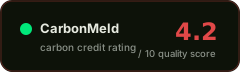
I privileged the more recent/explicit entries when resolving contradictions: for the FNRB method I privileged the local-field approach because the local-field documentation is later (2024 and reinforced by the 2025 monitoring report showing a field-derived FNRB of 0.81) than the older national-default record (2023). For leakage justification I privileged the most recent monitoring report (2025-02-12) that records leakage as 'quantified' and a 0% leakage deduction; this is taken as the current project position over an earlier 2024 note that did not address leakage. Both contradictions nonetheless reduce confidence and have been reflected by lowering transparency, claim safety, and documentation scores. Overall score (5.1) reflects moderate robustness with notable gaps in permanence disclosure, VVB identification, and public traceability.
Audit Analysis
Project shows moderate integrity: additionality was confirmed by a VVB and a project-specific baseline is used, but key permanence and leakage safeguards (buffer pool, reversal history) are not documented. Transparency and documentation are limited by missing VVB identification, incomplete error reporting and an evidence-docs gap. Claim safety is middling because methodological choices (local field FNRB, 0% leakage deduction) are plausible but contradicted by earlier documents and lack full public traceability.
Project Description
In Lango, access to safe water is a major challenge; boreholes to access groundwater often fall into disrepair due to a lack of funding or training for their maintenance. Having no safe water access forces communities to use unsafe sources such as streams to get their water - which has to be boiled to make it safe. To boil the water, communities collect and burn firewood, which places greater pressure on dwindling forests and produces CO2 emissions. It also creates a burden for women and children, who typically spend hours every day collecting firewood and water. Even so, boiling water does not always guarantee that it is safe to drink, so waterborne diseases continue to afflict the community. The first ever Gold Standard-certified gender responsive credits have been created by the Lango Safe Water Project. ‘Gender Responsive’ projects take a pro-active approach to promoting and implementing gender equality practices in the community where the project is based. This gives purchasers of carbon credits the opportunity to support a project that proactively support gender equality. Project Impacts and Benefits This is the first project to be certified under the Gold Standard's Gender Responsive Framework which means that the project has been rigorously assessed to reduce gender inequality. Since project implementation in 2019 the project has delivered the following impacts: 50,000 tonnes of CO2 emission reductions per year 40,000 individuals now enjoy clean water access, reducing the incidence of waterborne illness Nearly 4 hours saved per week for collecting water per household, which is a 19% improvement from the baseline, saving mostly women and young girls time Reduced school absenteeism due to less exposure to waterborne disease and less time spent collecting water Gender Equality Impacts: The local Water Resource Committee now has almost equal female to male representation, with 46% female to 54% male Reported
Red Flags
- VVB name not provided in extracted records
- Contradictory records on the FNRB method and prior non-addressing of leakage
- No buffer pool percentage or reversal history reported
Credit Vintages
| Issued | Retired | Available | ||
|---|---|---|---|---|
| 2019 | 1,636 | 1,636 | 0 | |
| 2020 | 5,809 | 5,809 | 0 | |
| 2021 | 3,773 | 3,727 | 46 | |
| 2022 | 3,213 | 883 | 2,330 | |
| 2023 | 6,143 | 0 | 6,143 | |
| 2024 | 2,152 | 0 | 2,152 | |
| Total | 22,726 | 12,055 | 10,671 |
Cosa migliorerebbe questo punteggio
- Provide explicit buffer pool/reversal arrangements and full leakage assessment documentation (with methodology and data) and reconcile earlier contradictory records.
Questi suggerimenti indicano quali prove pubbliche aggiuntive potrebbero migliorare il livello di confidenza di questa valutazione. Non garantiscono un punteggio futuro più alto.
Risk Indicators
VVB-confirmed
buffer/reversal not disclosed
0% deduction but inconsistent record
project-specific baseline
FPIC and grievance present
CORSIA/CCP status unknown
Where to buy
Marketplaces
+ Know where to buy this?
Listing multiple projects? Send us a CSV at [email protected].
⚑ Dispute this rating
Registry Documents
monitoring
- PoA GS1247 Annual-Report - signed.pdf
- Lango Uganda - T-PerfCert_V2.0-Project-Annual-Report-Form - Dec 2022 v2(6).pdf
- Monitoring Report_1st monitoring period_11.06.2019 to 31.03.2020_v5.pdf
- Lango Safe Water Project_ERs_MP6 (SWS caps applied) V4(3).xlsx
- Lango Uganda - T-PerfCert_V2.0-Project-Annual-Report-Form_2023.pdf
- Lango Safe Water Project_ERs_MP5 GS CAPS V4.xlsx
- +7 more
Other
pdd
validation
- 1.xlsx
- FVR_GS1247_v3.0_PoA_Clean.pdf
- Lango Safe Water Project_ERs_MP5 GS CAPS V3.xlsx
- GS1247_PoA-DD Clean_CP2_Improved Kitchen_19-02-2025.pdf
- Final-Verification-Report-GS5106-GS5186-GS5197-GS6349-GS6351-GS7362-GS7366-MP7-Lango-Project v.2.doc(5).pdf
- GS1247_Internal_Validation_PoA_13062013_final.pdf
- +3 more
Sei il proprietario di questo progetto?
Correzione metadati (gratuita)
Nome, paese, marketplace o link errati? Segnalacelo.
Non modifica lo score.
[email protected] →Rivalutazione con nuovi documenti
Hai documentazione aggiornata non ancora inclusa? Puoi richiedere un nuovo run della pipeline con i nuovi input.
Invia Documenti →