Welspun Renewable Energy Program
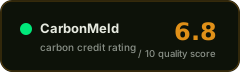
Score Breakdown
Integrity
verified Additionality is stated as confirmed by the VVB (monitoring report, 2022).
missing Baseline method and leakage treatment are not evidenced in the extracted record (monitoring report, 2022).
Transparency
verified VVB is identified (TÜV Rheinland (China) Ltd) and monitoring/crediting period is clearly stated (monitoring report, 2022).
missing Key MRV inputs (baseline method, leakage deduction, grid EF vintage) are not stated in the extracted record (monitoring report, 2022).
Claim Safety
missing Verified ERs exceed claimed ERs (283,819 vs 264,380) in the monitoring report (2022), increasing QA/over-crediting concern.
inferred CORSIA and CCP status are not stated in the extracted record, limiting confidence for downstream claims (available documents).
Documentation
verified Two core documents are available (validation report and monitoring report) with high extraction confidence.
missing Safeguards, FPIC, grievance mechanism, and benefit-sharing are not documented in the extracted record (available documents).
Detailed Analysis
Integrity
The monitoring report (2022) indicates additionality was confirmed by the VVB, which supports additionality at a high level. However, the baseline method is not stated in the extracted record, and there is no evidence of when (or whether) the baseline was last reassessed, which weakens confidence in baseline validity for a grid-connected renewable program. Leakage is explicitly not addressed and no leakage deduction is stated in the extracted record, leaving an integrity gap even if leakage is likely small for this sector.
Transparency
The monitoring report (2022) provides a clear monitoring/crediting period (2013-03-31 to 2020-03-30) and identifies the VVB as TÜV Rheinland (China) Ltd. A grid emission factor value is provided (0.9528), but the year/vintage of the grid EF is not stated in the extracted record, limiting reproducibility. The absence of stated baseline method and leakage deduction in the extracted record reduces MRV transparency.
Claim Safety
A key concern is that the monitoring report (2022) shows total verified ERs (283,819) higher than total claimed ERs (264,380); without an explanation, this is atypical and increases the risk of misunderstanding or misreporting in public claims. CORSIA eligibility and CCP status are not stated in the extracted record, so buyers cannot easily assess whether credits might be used across multiple claim channels. Leakage is not addressed in the extracted record, which also increases the risk of overstated net climate benefit in marketing claims.
Documentation
The extracted record includes two core document types (validation report and monitoring report) and the minimum extraction confidence is high, supporting basic document reliability. The monitoring report is dated 2022-09-26 and covers the 2013–2020 period, which is reasonably complete for that interval. However, safeguards-related elements (FPIC, grievance mechanism, benefit-sharing, and safeguards mention) are not evidenced in the extracted record, reducing documentation completeness for non-carbon aspects.
Overall
There are no listed contradictions between documents in the extracted record, so no cross-document reconciliation was required. The main reliability issue is internal: the monitoring report (2022) reports verified ERs higher than claimed ERs, which warrants clarification and lowers confidence in claim safety. Overall scoring reflects moderate assurance (named VVB, no material findings) but meaningful evidence gaps on baseline and leakage, and missing safeguards documentation. (Gate rules note: if documentation were below 3.0, transparency would be capped; if integrity were below 4.0, overall would be capped at 6.0.)
Audit Analysis
The project has basic third-party assurance and a clear monitoring/crediting period, but key integrity elements (baseline approach, leakage treatment, and reassessment timing) are not evidenced in the extracted record. The verified ERs exceed the claimed ERs in the monitoring report, which raises over-crediting/QA concerns even though no material findings or corrective actions are reported.
Red Flags
- Baseline approach and any baseline reassessment timing are not stated in the extracted record, despite being central to grid-connected renewable additionality and quantification.
- Leakage is not addressed and no leakage deduction is stated, leaving an MRV gap even if leakage is expected to be low for this project type.
- The monitoring report shows verified ERs (283,819) higher than claimed ERs (264,380), which is unusual and increases over-crediting/QA risk without further explanation.
Credit Vintages
Nessuna emissione registrata sul registro.
Il marketplace dichiara i vintage: 2013 (non verificato).
Cosa migliorerebbe questo punteggio
- Disclose the baseline approach used (including grid EF vintage/source and any baseline reassessment) and provide enough detail for third-party reproduction of ER calculations.
- Provide an explicit leakage assessment (even if concluded negligible) and state any leakage deduction applied.
- Clarify why verified ERs exceed claimed ERs in the monitoring report and publish a reconciliation note or corrected summary table.
Questi suggerimenti indicano quali prove pubbliche aggiuntive potrebbero migliorare il livello di confidenza di questa valutazione. Non garantiscono un punteggio futuro più alto.
Risk Indicators
VVB-confirmed additionality stated
Avoidance project; no reversal risk evidenced
Leakage not addressed; no deduction stated
Baseline approach not evidenced in extracted record
No FPIC/grievance mechanism evidenced
CORSIA/CCP status not stated
Where to buy
Marketplaces
+ Know where to buy this?
Listing multiple projects? Send us a CSV at [email protected].
⚑ Dispute this rating
Sei il proprietario di questo progetto?
Correzione metadati (gratuita)
Nome, paese, marketplace o link errati? Segnalacelo.
Non modifica lo score.
[email protected] →Rivalutazione con nuovi documenti
Hai documentazione aggiornata non ancora inclusa? Puoi richiedere un nuovo run della pipeline con i nuovi input.
Invia Documenti →