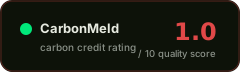
Summerley Hall Fruit Farm
DV-4c08aa
Score Breakdown
Integrity
missing Additionality, baseline approach, leakage treatment, and permanence controls are not stated in the extracted record (documents include a monitoring report and an unknown document type, dated 2022).
inferred No material findings or corrective actions are listed, but the underlying verification/assurance evidence is not provided in the extracted record.
Transparency
missing Key MRV outputs (claimed vs verified removals) and the verifier identity are not stated in available documents.
verified A usage monitoring method is specified as smart metering in the extracted record.
Claim Safety
missing Over-crediting risk is elevated because baseline, leakage, and verified vs claimed results are not stated in available documents.
inferred CORSIA eligibility and CCP status are not stated in available documents, leaving double-claim/market-eligibility risk unclear.
Documentation
missing Minimum extraction confidence is low and the document type is partly unknown, limiting auditability of key claims.
inferred Only a small set of evidence documents is referenced (monitoring report plus unknown), with major gaps in quantified parameters.
Detailed Analysis
Integrity
The extracted record does not state any additionality test or whether additionality was confirmed by an independent verifier, which is a major integrity gap for credit issuance. The baseline method and any baseline reassessment timing are also not stated in available documents, making it difficult to judge whether credited outcomes are truly beyond business-as-usual. For permanence, neither a buffer pool contribution nor any reversal monitoring/events are stated in the extracted record, which is particularly important for soil carbon where reversals can occur. Leakage is not quantified and no leakage justification is provided in the extracted record (monitoring report referenced; 2022 document date), increasing the risk that net climate benefit is overstated.
Transparency
Transparency is limited because the verifier name is not stated and the monitoring period is not stated in the extracted record, preventing a clear understanding of what time window the reported outcomes cover. The extracted record also does not provide claimed versus verified total removals, so users cannot reconcile issuance with measured performance. A positive element is that a usage monitoring method is specified as smart metering, but this alone does not substitute for full MRV disclosure. Overall, the evidence set (monitoring report plus an unknown document type) is insufficiently detailed for independent scrutiny.
Claim Safety
Claim safety is weak because the extracted record lacks the core accounting parameters that typically drive over-crediting risk: baseline approach, leakage treatment, and verified results. CORSIA eligibility and CCP status are not stated in available documents, so buyers cannot easily assess market-eligibility claims or potential double-claim concerns. The absence of disclosed claimed-versus-verified totals further increases greenwashing risk, because there is no transparent check on whether credits align with verified outcomes. Given the low extraction confidence, any marketing claims should be treated cautiously until primary documents are reviewed.
Documentation
Documentation quality is low: the minimum extraction confidence is reported as low, indicating at least one key document was poorly readable, which reduces confidence that all relevant details were captured. The extracted record references three documents, but only identifies a monitoring report and an unknown document type, and does not surface standard elements like methodology, crediting period, verifier identity, or quantified results. While no material findings or corrective actions are listed, the absence of an identifiable verification/assurance report in the extracted record limits the value of that signal. The 2022 document date suggests some recency, but completeness is the binding constraint.
Overall
Overall quality is constrained by missing fundamentals (additionality, baseline, leakage, permanence controls, and quantified verified outcomes) and low extraction confidence, which together elevate integrity and over-crediting concerns. There are no contradictions reported in the extracted record, so no cross-document discrepancies could be resolved; however, the lack of contradictions likely reflects missing data rather than strong consistency. Where choices were required, the assessment privileges what is explicitly present in the extracted record (e.g., smart metering is noted) and treats all unstated items conservatively as evidence gaps. Note: under the gate rules, a documentation score below 3.0 would cap the transparency score after scoring.
Audit Analysis
Available documentation for this soil carbon project is too thin to substantiate core quality claims such as additionality, baseline setting, leakage treatment, and permanence controls. While a monitoring approach is referenced (smart metering), most key MRV and accounting parameters are not stated in the extracted record, increasing over-crediting and greenwashing risk.
Project Description
We farm approximately 108 acres. The farm is mostly permanent pasture, and we also have just over 16 acres of woodland (a 50/50 split of old established natural woodland and a new area of trees planted in 2008). There are almost 4km of hedgerows on the farm, most of which are very large (3m+ high and of a similar width). These are all old hedgerows that have existed for many years, although they’ve been allowed to grow out much more in the last 10-15 years, since we entered the farm into steward
Red Flags
- Additionality approach and whether it was independently validated are not stated in available documents.
- Baseline method and any baseline reassessment timing are not stated in available documents.
- No leakage deduction or leakage justification is stated in available documents for a project type where leakage and boundary effects can be material.
- Permanence controls (buffer contribution and any reversal monitoring/events) are not stated in available documents.
- Low document readability/extraction confidence reduces confidence in the completeness and reliability of the extracted record.
Credit Vintages
Nessuna emissione registrata sul registro.
Cosa migliorerebbe questo punteggio
- Publish or provide the methodology and baseline approach (including reassessment schedule) and disclose claimed vs verified removals for a clearly defined monitoring period.
- Document permanence risk management for soil carbon (buffer contribution, reversal monitoring and response procedures) and provide a leakage assessment with quantified deductions or a robust justification for negligible leakage.
- Provide an identifiable independent assurance/verification statement (including verifier name) and improve document legibility to raise extraction confidence.
Questi suggerimenti indicano quali prove pubbliche aggiuntive potrebbero migliorare il livello di confidenza di questa valutazione. Non garantiscono un punteggio futuro più alto.
Risk Indicators
No additionality assessment found
Permanence controls not evidenced
Leakage not quantified or justified
Baseline method not stated
Safeguards not evidenced; no grievance mechanism
CORSIA/CCP status not stated
Where to buy
Marketplaces
+ Know where to buy this?
Listing multiple projects? Send us a CSV at [email protected].
⚑ Dispute this rating
Sei il proprietario di questo progetto?
Correzione metadati (gratuita)
Nome, paese, marketplace o link errati? Segnalacelo.
Non modifica lo score.
[email protected] →Rivalutazione con nuovi documenti
Hai documentazione aggiornata non ancora inclusa? Puoi richiedere un nuovo run della pipeline con i nuovi input.
Invia Documenti →