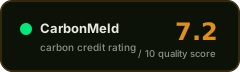
National Solar Power Development Programme, India
Score Breakdown
Integrity
verified Additionality is confirmed by the VVB in the monitoring report (2026).
missing Leakage is not addressed in the monitoring report (2026), and no leakage deduction is stated.
Transparency
verified Multiple core documents are available (PDD, validation report, monitoring report, issuance).
missing The monitoring report (2026) shows a sizable difference between claimed and verified ERs (76,476 vs 67,369).
Claim Safety
verified The project is explicitly not CORSIA-eligible in the monitoring report (2026).
missing Baseline is project-specific and baseline reassessment timing is not stated, increasing over-crediting risk.
Documentation
verified Document set is relatively complete (7 documents including PDD, validation, monitoring, issuance) with high extraction confidence.
missing Safeguards information is inconsistent between the validation report (2012) and monitoring report (2026).
Detailed Analysis
Integrity
The monitoring report (2026) indicates additionality was confirmed by the VVB, but the type of additionality test is not stated in the extracted record, limiting robustness assessment. The baseline is project-specific under AMS-I.D. (version 17), and the timing of any baseline reassessment is not stated, which weakens confidence that the baseline remains conservative over time. Leakage is not addressed and no leakage deduction is stated in the monitoring report (2026), which is a notable integrity gap even for grid-connected renewables where leakage is often argued negligible.
Transparency
The project identifies the VVB (Bureau Veritas Certification) and provides a long monitoring period (2012-07-15 to 2020-12-31) in the monitoring report (2026), supporting traceability. However, the monitoring report (2026) shows claimed ERs of 76,476 versus verified ERs of 67,369, suggesting quantification adjustments that should be clearly explained to users. Some MRV-relevant fields (such as the usage monitoring method) are not stated in the extracted record, reducing transparency on how generation/exports were measured.
Claim Safety
CORSIA eligibility is explicitly false in the monitoring report (2026), lowering the risk of aviation-related double-claiming. CCP status is not stated in available documents, so buyers cannot easily assess alignment with CCP-style quality screens. Over-crediting risk remains moderate because the baseline is project-specific and baseline reassessment timing is not stated, and because leakage treatment is absent rather than explicitly justified as negligible.
Documentation
The evidence set includes issuance, validation report, monitoring report, and PDD, with 7 documents used and high extraction confidence, which supports document completeness. No material findings or corrective actions are reported in the monitoring report (2026), which is a positive signal for audit closure. Nonetheless, safeguards-related disclosure is inconsistent across documents, which reduces confidence in the completeness and consistency of non-carbon documentation.
Overall
Overall quality is mid-range: verification appears in place and documentation coverage is decent, but key conservativeness checks (leakage treatment and baseline reassessment timing) are not evidenced in the extracted record. The claimed-versus-verified ER gap (76,476 vs 67,369) in the monitoring report (2026) increases uncertainty and should be explained for buyer confidence. Contradiction addressed: safeguards are marked as mentioned in the validation report (2012) but not mentioned in the monitoring report (2026); I privilege the more recent monitoring report for current disclosure status while treating the inconsistency as a reliability issue and lowering documentation/transparency accordingly. Gate rules note: documentation is above 3.0 and integrity is above 4.0, so no automatic caps would apply.
Audit Analysis
This is a grid-connected solar avoidance project verified by Bureau Veritas with no material findings reported, but several core integrity elements are weakly evidenced in the extracted record. Leakage is not addressed and baseline reassessment timing is not stated, increasing over-crediting uncertainty. CORSIA is explicitly not eligible, which reduces aviation-claim risk, but safeguards documentation is inconsistent across documents.
Project Description
Initially submitted at the time of requesting registration of the POA: - CPA - 001: 5 MW Solar PV power project, Patan District, Gujarat, India This Programme of Activities (PoA) generates solar power which is supplied to the grid system of India. The PoA’s objective is to develop a carbon platform for overcoming hurdles encountered during implementation of small-scale solar power projects in India. The project activities under this PoA are the first of their kind…
Red Flags
- Leakage is not addressed and no leakage deduction is stated in available documents.
- Baseline is project-specific and the timing of any baseline reassessment is not stated.
- Safeguards disclosure is contradictory between the validation report (2012) and monitoring report (2026).
- Large gap between claimed and verified emission reductions (76,476 vs 67,369) indicates MRV/quantification uncertainty.
Credit Vintages
Nessuna emissione registrata sul registro.
Il marketplace dichiara i vintage: 2013 (non verificato).
Cosa migliorerebbe questo punteggio
- Provide explicit leakage assessment (even if negligible) and state the applied leakage deduction, with justification in the monitoring/verification documentation.
- Disclose the specific additionality test applied (e.g., investment/barrier/common practice) and provide supporting calculations or evidence referenced by the VVB.
- Clarify baseline update/reassessment approach and timing for the grid emission factor and baseline parameters over the monitoring period.
Questi suggerimenti indicano quali prove pubbliche aggiuntive potrebbero migliorare il livello di confidenza di questa valutazione. Non garantiscono un punteggio futuro più alto.
Risk Indicators
VVB confirms additionality, but test type not evidenced
Avoidance renewable project with no reversal events reported
Leakage not addressed and no deduction stated
Project-specific baseline; reassessment timing not stated
No FPIC or grievance mechanism documented; safeguards inconsistent
Not CORSIA-eligible; CCP status not stated
Where to buy
Marketplaces
+ Know where to buy this?
Listing multiple projects? Send us a CSV at [email protected].
⚑ Dispute this rating
Registry Documents
Sei il proprietario di questo progetto?
Correzione metadati (gratuita)
Nome, paese, marketplace o link errati? Segnalacelo.
Non modifica lo score.
[email protected] →Rivalutazione con nuovi documenti
Hai documentazione aggiornata non ancora inclusa? Puoi richiedere un nuovo run della pipeline con i nuovi input.
Invia Documenti →