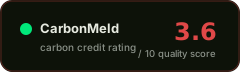
Pyrocal - Wellcamp
Score Breakdown
Integrity
verified The verification report (2024-09-23) confirms additionality using an investment test.
missing Baseline method and leakage treatment were not found in the extracted record, and the verification report (2024-09-23) required corrective actions on LCA inputs and biochar yield.
Transparency
verified A VVB is identified (EnergyLink Services Pty Ltd) and a monitoring period is specified (2022-01-01 to 2023-06-30).
missing Claimed vs verified net removals and the usage monitoring approach were not found in the extracted record; minimum extraction confidence is low.
Claim Safety
verified The project is explicitly not CORSIA-eligible in the extracted record, reducing one channel of double-claim risk.
missing Over-crediting risk cannot be well assessed because verified net removals, baseline method, and leakage treatment were not found in the extracted record.
Documentation
missing Minimum extraction confidence is low and the evidence document list is not specific (listed as “unknown”).
missing The verification report (2024-09-23) lists multiple corrective actions (LCA template/period/inputs, client declarations/CORC calculation, biochar yield), indicating documentation gaps at verification.
Detailed Analysis
Integrity
The verification report (2024-09-23) confirms additionality via an investment test, which supports additionality robustness. However, the baseline approach and any baseline reassessment timing were not found in the extracted record, making it difficult to judge baseline validity. Leakage treatment (deduction and justification) was also not found in the extracted record, and the verification report (2024-09-23) required corrective actions related to LCA inputs and biochar yield, which are central to quantifying durable carbon removal.
Transparency
The extracted record identifies the VVB as EnergyLink Services Pty Ltd and provides a monitoring period of 2022-01-01 to 2023-06-30, which is a basic transparency positive. But the claimed and verified net removals were not found in the extracted record, preventing a check of what was issued versus what was verified. Minimum extraction confidence is low and the evidence documents are not clearly enumerated (shown as “unknown”), reducing confidence in the completeness of the public record.
Claim Safety
The project is marked as not CORSIA-eligible in the extracted record, which lowers the risk of CORSIA-related double claiming. CCP status was not found in the extracted record, so alignment with higher-integrity labels cannot be confirmed. Because baseline method, leakage treatment, and verified net removals were not found in the extracted record, there is elevated greenwashing/over-crediting risk from an inability to independently validate the magnitude of removals.
Documentation
Although 7 documents were used in extraction, the minimum extraction confidence is low, indicating at least one key document was poorly readable, which materially weakens documentation reliability. The evidence document list is not specific (listed as “unknown”), limiting traceability. The verification report (2024-09-23) includes several corrective actions (LCA template and inputs, reporting period, client declarations/CORC calculation, and biochar yield), suggesting the documentation package required substantive fixes.
Overall
Overall quality is constrained by missing core quantification fields (baseline method, leakage treatment, and claimed/verified net removals) and by low extraction confidence, which together reduce confidence in the accuracy of credited removals. A key contradiction exists on whether safeguards are mentioned: a 2024-09-23 document indicates safeguards are mentioned, while a 2022-02-17 document indicates they are not. I privilege the more recent 2024-09-23 verification report as the higher-priority, later-stage assurance document, but the inconsistency still lowers confidence and slightly depresses transparency/documentation scoring. Note: if documentation remains below 3.0, transparency may be capped by the gate rule applied after scoring.
Audit Analysis
This Puro biochar removal project has VVB-confirmed additionality via an investment test and a stated 2.5% buffer contribution, but key quantification elements (baseline approach, leakage treatment, and verified net removals) were not found in the extracted record. Low document readability and multiple corrective actions in the verification report increase uncertainty and reduce confidence in the robustness of claims.
Project Description
Our location in South East Queensland, Australia is surrounded by an abundant supply of the following organic feedstocks from which high-quality biochar is produced using Pyrocal’s CCT systems. These feedstocks would otherwise go to a less beneficial use, landfill or be incinerated: Macadamia, pecan and walnut nutshells that are a by-product of the nut processing industry. Used, heat treated, pine wood pallets. For each metric ton of pecan shell, macadamia shell, walnut shell and pine pallet processed, the CCT system produces 270, 250, 260 and 250 kg of biochar, with carbon contents of 83, 85, 81 and 88 percent, respectively. The feedstock is reduced in volume by approximately 75 percent when transformed into biochar, with the sequestered carbon locked away for 100’s of years. We sell the biochar as a soil amendment and stock feed additive which means 100 percent of the nutshells and used pine wood is diverted from waste disposal. Biochar from Pyrocal’s Continuous Carbonisation Technology (CCT) system complies with stringent government emissions regulations and meets the International Biochar Initiative (IBI) standards. Pyrocal CCT Systems We design and manufacture Pyrocal CCT systems for business and government customers worldwide. Pyrocal systems can also be configured to transform more challenging residual waste streams such as Municipal Solid Waste, car tyres and industrial by-products into carbon-stabilised char. Pyrocal is Australian owned and has been implementing CCT systems here in Australia and internationally since 2014.
Red Flags
- Verified and claimed net removals were not found in the extracted record, limiting the ability to assess over-crediting risk.
- Baseline approach and any baseline reassessment timing were not found in the extracted record.
- Leakage deduction and justification were not found in the extracted record for a biochar supply-chain project type where leakage can be material.
- Minimum extraction confidence is low and the verification report lists multiple corrective actions (LCA template/inputs, client declarations/CORC calculation, biochar yield).
Credit Vintages Exhausted
| Issued | Retired | Available | ||
|---|---|---|---|---|
| 2022 | 101 | 101 | 0 | |
| 2024 | 63 | 63 | 0 | |
| Total | 164 | 164 | 0 |
Cosa migliorerebbe questo punteggio
- Publish or clearly reference the verified net removals for the monitoring period (2022-01-01 to 2023-06-30) and reconcile claimed vs verified figures in the verification/registry record.
- Disclose the baseline approach and leakage assessment (including any deduction and justification) and provide the finalized LCA inputs/yield evidence addressing the corrective actions in the 2024-09-23 verification report.
Questi suggerimenti indicano quali prove pubbliche aggiuntive potrebbero migliorare il livello di confidenza di questa valutazione. Non garantiscono un punteggio futuro più alto.
Risk Indicators
VVB-confirmed investment test
Buffer stated (2.5%), reversals not evidenced
Leakage treatment not found
Baseline method not found
Safeguards inconsistently documented; no FPIC/grievance
Not CORSIA-eligible; CCP status not found
Where to buy
Marketplaces
+ Know where to buy this?
Listing multiple projects? Send us a CSV at [email protected].
⚑ Dispute this rating
Sei il proprietario di questo progetto?
Correzione metadati (gratuita)
Nome, paese, marketplace o link errati? Segnalacelo.
Non modifica lo score.
[email protected] →Rivalutazione con nuovi documenti
Hai documentazione aggiornata non ancora inclusa? Puoi richiedere un nuovo run della pipeline con i nuovi input.
Invia Documenti →